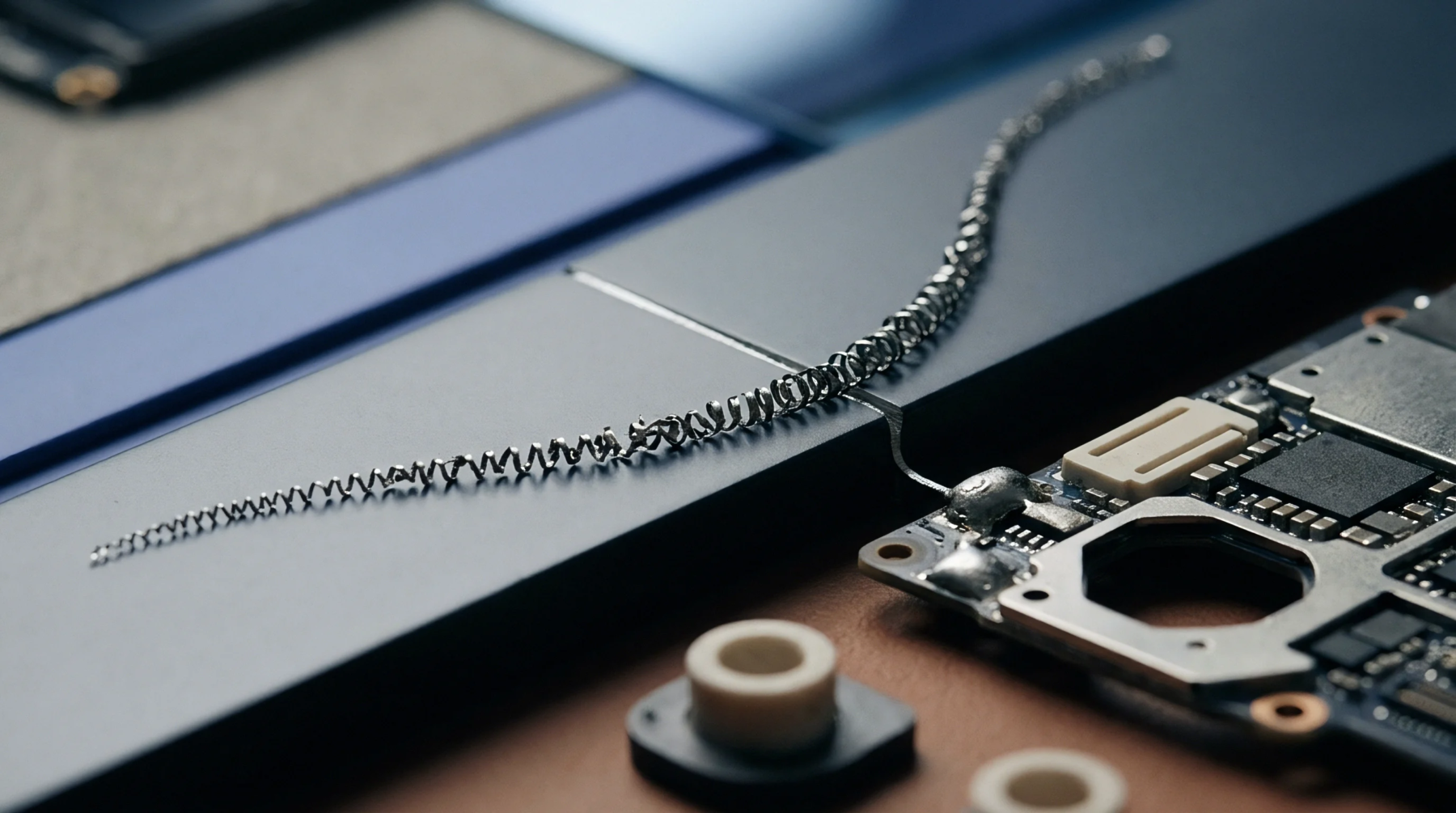
Non Equilibrium Point Defect Kinetics during Rapid Metal Phase Transformations
Excess vacancies trapped during rapid quenching accelerate solute clustering and require low-temperature recovery dwell cycles before precipitation aging.
Excess vacancies trapped during rapid quenching accelerate solute clustering and require low-temperature recovery dwell cycles before precipitation aging.

Mitigating vacancy transport in sub-five-micrometer microbumps requires controlling grain orientation and limiting local thermal gradients below 1000 C/cm.

Electromigration accelerates intermetallic growth at bump corners twentyfold, requiring nickel barriers and copper pillars to prevent voiding failures.

Electroplated copper microbump voids nucleate when bath additive sulfur impurities catalyze vacancy condensation along the Cu-Cu3Sn boundary during thermal aging.

Anisotropic vacancy diffusion along the c-axis of single-grain solder microbumps drives rapid thermomigration voiding under dynamic thermal gradients.

Fine pitch microbump reliability requires multiphysics modeling of coupled current crowding and thermal gradients to prevent early life voiding failures.

Microbump mass transport flux accelerates through coupled electrothermal gradients, requiring precise flux divergence modeling to prevent interconnect open circuits.

Areal optical and contact stylus profilometry diverge by 15-40% due to tip geometry, optical phase shifts, and filtering; contracts must specify the exact method.

Thermal expansion in micro machined aluminum consumes bilateral micron tolerances unless inspection temperature, soak duration, and compensation routines match ISO 1.

Certified step standards align non-contact metrology tools across supply chains, eliminating phase anomalies, tool drift, and expensive production scrap.

Electromigration drives rapid intermetallic phase breakdown at current densities over 10^4 A/cm2, requiring barrier controls and continuous resistance testing.

Reliable lead-free interconnects depend on controlling intermetallic growth, microvoid formation, and grain recrystallization through alloy specification.

Maintain post-reflow intermetallic compound layers between 0.8 and 1.5 microns through controlled thermal profiles to prevent brittle drop failures.

Dynamic spectral thresholding memory overhead scales with window height and numeric precision, requiring on-chip staging to avoid dropped scan lines.

Hardware frame rate delay registers align distributed spatial and spectral line-scan cameras by buffering pixel data to match mechanical web transit offsets.

Line calibration for push-broom NIR sensors locks spatial-spectral pixel registration against mechanical drift, preventing costly sorting errors.

Microbump degradation limits depend on anisotropic tin grain orientation and viscoplastic strain energy density accumulated within the intermetallic boundary layer.

Mitigate voiding by controlling pad plating impurities, restricting Cu3Sn thickness below 0.8 micrometers, and optimizing underfill to eliminate triaxial tension.

Fine-pitch microbumps solidify as anisotropic single crystals whose c-axis alignment dictates catastrophic electromigration and thermomechanical fatigue rates.

Micro-alloying low-silver solder with nickel or zinc suppresses vacancy coalescence by halting Cu3Sn growth and counteracting copper plating impurities.

Calculate intermetallic layer growth using parabolic diffusion equations to cap high-temperature joint failure and enforce reflow thermal limits.

Thermal heat drives creep and intermetallic voiding in lead-free solder; buyers must specify alloy chemistry, cooling rates, and interface void limits.

Isothermal aging drives intermetallic compound growth and vacancy voiding, requiring palladium barrier layers and tight phosphorus control to prevent joint failure.

Electromigration and Kirkendall voiding accelerate at micro BGA cathode traces, requiring strict plating purity controls and microstructural void limits.

Microbump reliability under thermal stress requires tight plating impurity controls to prevent accelerated Kirkendall voiding along brittle intermetallic boundaries.

Sub-ten-micrometer packaging requires SPC limits set at 1.2-micrometer void diameter and 3.0 percent interfacial area, enforced by automated tool interlocks.
Maintain tight bleed feed dosing and ion exchange separation to halt additive breakdown before microvoids compromise high density pillar coplanarity.

Copper plating defects in advanced packaging stem from additive imbalance and flow stagnation; real-time CVS monitoring and seed integrity prevent scrap.

Factory failure cost recovery succeeds through immediate receiving dock triage, auditable debit notes, and cross-border contract terms enforceable in China.

Overseas supplier oversight relies on physical golden samples, daily telemetry, gated escalation pathways, and enforced contractual offsets against open orders.
Expertise is a utility, not a secret. sentiention™ publishes its working knowledge as open reference: intelligence layer covering the materials it sources, the markets it enters, and the reference that serves both.