Stress Assisted Vacancy Migration Dynamics in Intermetallic Compounds under Shock
Dynamic shock stress alters vacancy migration enthalpy and induces rapid directional diffusion, driving void nucleation and spall failure in intermetallics.

Lattice

Ordered Superstructures under Dynamic Loading
Planar shock compression introduces severe deviatoric stress states into ordered intermetallic alloys on picosecond timescales. Ordered intermetallic compounds, specifically L1₂ structured nickel aluminides and B2 structured titanium aluminides, possess distinct sublattices whose long-range ordering energy strongly impedes conventional dislocation glide. When a shock wave exceeds the Hugoniot elastic limit, typically between 3.5 and 8.0 gigapascals in these alloy classes, plastic relaxation occurs through the forced generation of non-equilibrium point defects alongside deformation twinning and anti-phase boundary formation.
Shock fronts drive instantaneous atomic volume contractions exceeding six percent. This compression lowers the formation enthalpy of vacancies on specific atomic sites while simultaneously altering the directional migration barriers along close-packed directions.
Shock compression couples an anisotropic stress tensor directly to the migration barrier. Uniaxial strain across the shock front breaks cubic lattice symmetry, lifting the degeneracy of nearest-neighbor jump vectors. In an ordered B2 lattice such as FeAl or TiAl, vacancy jumps along the ⟨111⟩ direction require movement across alternating elemental planes, briefly creating high-energy anti-structure defects.
Deviatoric shear components resolve along slip systems, lowering migration enthalpy in dilational jump trajectories by up to 0.45 electron-volts while steepening barriers in opposing vectors. Vacancies migrate directionally under these conditions rather than executing isotropic random walks.
A uniaxial shock strain of seven percent lowers migration enthalpy along active shear directions by roughly 0.4 electron-volts.
Non-conservative dislocation motion under extreme strain rates generates excess vacancies far above thermodynamic equilibrium. Dislocation intersections form jogs on screw segments. Forced glide of jogged screw dislocations leaves behind continuous trails of point defects when thermal energy is insufficient to permit conservative climb.
Dynamic vacancy concentrations behind the shock front reach atomic fractions between 10⁻⁴ and 10⁻³, values otherwise observed only within several degrees of the melting point. These non-equilibrium point defect populations persist within the high-strain wake for several microseconds, accelerating structural reorganization, phase inversion, and localized chemical disordering before macroscopic thermal dissipation occurs.
The resulting directional migration rates govern dynamic void nucleation and local chemical redistribution during post-shock recovery. Vacancy populations cluster preferentially along shock-induced twin boundaries and shearing planes where local stress concentrations persist.


Barrier
Enthalpy Landscapes across Sublattices
Migration kinetics in ordered intermetallic lattices depend on site specificity. In ordered stoichiometric Ni₃Al, vacancies reside either on the face-centered nickel sublattice or the corner aluminum sublattice. A vacancy executing a jump within the nickel sublattice preserves the local chemical order parameter.
A jump originating on an aluminum site directly alters nearest-neighbor coordinating chemistry, introducing severe electrostatic and bonding penalties.
| Intermetallic Compound | Sublattice Site | Migration Direction | Zero-Stress Enthalpy (eV) | 10 GPa Shock Enthalpy (eV) | Volume Change (ų) |
|---|---|---|---|---|---|
| Ni₃Al (L1₂) | Ni Site | ⟨110⟩ | 1.28 | 0.84 | -1.82 |
| Ni₃Al (L1₂) | Al Site | ⟨110⟩ | 1.76 | 1.31 | -2.15 |
| TiAl (L1₀) | Ti Site | ⟨101] | 1.45 | 0.98 | -1.64 |
| TiAl (L1₀) | Al Site | ⟨110] | 1.62 | 1.12 | -1.90 |
| FeAl (B2) | Fe Site | ⟨111⟩ | 1.58 | 1.05 | -2.40 |
| FeAl (B2) | Al Site | ⟨100⟩ | 2.10 | 1.67 | -2.05 |
Applied shock stresses modulate activation barriers through the mechanical work term, written as the trace product of the local stress tensor and the vacancy relaxation strain tensor. Compressive hydrostatics raise absolute formation energy, but the massive deviatoric stress components operative along the Hugoniot state drop the saddle-point energy for atomic displacement into adjacent vacant volumes. Shock waves with rise times under ten nanoseconds introduce shear strains that distort the coordination cage surrounding a vacant site.
This distortion reduces the distance between the migrating atom and the vacancy saddle point along the propagation axis.
Which Mechanisms Alter Jump Frequencies?
Jump frequencies shift dramatically when dynamic shock pressures exceed five gigapascals. The transition rate follows an adapted Arrhenius form wherein directional stress alters the effective activation energy. Anisotropic strain fields shorten bond lengths perpendicular to the propagation axis while elongating or shearing bonds aligned with the maximum shear direction.
The effective attempt frequency, typically near 10¹³ hertz under equilibrium, increases by a factor of 1.5 to 2.8 due to lattice stiffening under high-density shock states.
The change in migration enthalpy under shock relates directly to the local activation volume. Negative activation volumes indicate that the transition state occupies a smaller local volume than the ground state configuration, a condition prevalent in close-packed L1₂ systems. Under compressive shock, negative activation volumes yield a substantial reduction in effective migration enthalpy along vectors experiencing dilational shear.
In FeAl and similar B2 intermetallics, directional jump frequencies along the shock axis accelerate by up to four orders of magnitude compared to unshocked thermal diffusion at equivalent temperatures.
Calculations show that if the activation volume of an aluminum-site vacancy in Ni₃Al equals -2.15 cubic angstroms, an applied deviatoric stress of three gigapascals lowers the migration barrier by approximately 0.45 electron-volts. A lower migration barrier causes vacancies that would remain immobile on microsecond timescales to execute dozens of atomic jumps during the immediate passage of the plastic shock front. Order-disorder transitions in shock-recovered intermetallics proceed far more rapidly than predicted by ambient diffusion equations.
Dislocation core atmospheres collect these rapidly migrating point defects, initiating secondary slip pinning.

Flux
Stress-Gradient Driven Point Defect Transport
Shock compression creates steep spatial gradients in both hydrostatic pressure and deviatoric shear across the shock front thickness, which spans only tens to hundreds of nanometers in metallic materials. These stress gradients act as a powerful mechanical driving force for vacancy drift, superimposing a directed drift velocity on random thermal hops. The directional flux of vacancies responds directly to the gradient of the chemical potential, which incorporates the interaction between the vacancy relaxation volume and the local stress gradient.
The drift velocity depends on the product of the vacancy mobility and the mechanical driving force. When a shock wave propagates through an intermetallic specimen, the spatial derivative of the stress tensor reaches magnitudes of 10¹⁵ to 10¹⁶ pascals per meter across the wave front. Vacancies experience a net force pushing them toward regions of lower compressive stress or high dilational shear.
In the wake of the shock front, where stress releases dynamically through interaction with reflected release waves, the sign of the stress gradient reverses, redirecting the vacancy flux toward the newly formed free surfaces or spall planes.
ASTM E2283 requires rigorous extreme-value statistical distributions to evaluate defect clusters that trigger premature spall failure.
Dynamic flux calculations must account for the distinct mobilities across ordered sublattices. In ternary titanium aluminides, titanium vacancies display mobility values roughly three times higher than aluminum vacancies under identical shock-induced shear. This mobility divergence induces preferential chemical demixing along the path of maximum shock shear.
Regions undergoing intense dynamic deformation experience transient stoichiometric drift, forming micro-domains enriched in anti-site defects that act as precursors for localized phase transformations.

Dynamic Clustering and Void Embryo Formation
Rapid vacancy flux under shock conditions leads to supersaturation levels that cannot be maintained by the host matrix. As the compressive wave passes and trailing release waves lower the local hydrostatic pressure, super-saturated vacancies coalesce into vacancy discs and three-dimensional clusters. In L1₂ and B2 structures, such coalescence exhibits unique geometrical constraints:
- Prismatic Dislocation Loops form when two-dimensional vacancy discs collapse on close-packed planes, introducing fault energy penalties that depend on whether the loop shears the ordered sublattice.
- Stacking Fault Tetrahedra nucleate in low fault-energy intermetallics through the Silcox-Hirsch mechanism, creating stable three-dimensional barriers that permanently harden the material against subsequent dynamic deformation.
- Nanoscale Void Embryos emerge when the vacancy supersaturation exceeds critical chemical potential limits, acting as primary nucleation sites for spall fracture during shock release.
- Anti-Phase Boundary Networks form around imperfectly collapsed clusters, leaving localized tubes of chemical disorder that alter downstream dislocation passage.
The concentration of these clustered formations scales with peak shock pressure and pulse duration. A flat plateau shock pulse holding peak pressure for twenty nanoseconds produces five to ten times more nanoscale void embryos than a triangular pulse of identical peak amplitude. The trailing release wave converts these embryos into expanding macroscopic voids, culminating in dynamic spall failure under tensile reflection.
Dynamic consolidation tests on shock-loaded Fe-40Al intermetallic specimens illustrate these clustering kinetics. The table below outlines observed cluster densities and dominant morphology types across different shock stress levels, based on post-impact transmission electron microscopy studies.
| Peak Shock Stress (GPa) | Pulse Duration (ns) | Mean Cluster Diameter (nm) | Number Density (m⁻³) | Dominant Cluster Morphology |
|---|---|---|---|---|
| 4.2 | 15 | 1.8 | 2.4 × 10²¹ | Small Dislocation Loops |
| 7.8 | 15 | 3.2 | 8.6 × 10²¹ | Stacking Fault Tetrahedra |
| 11.5 | 15 | 5.4 | 3.1 × 10²² | Nanovoids and Cavities |
| 15.0 | 15 | 8.1 | 9.4 × 10²² | Interconnected Void Networks |
Underestimating the rate of shock-assisted vacancy aggregation leads to catastrophic miscalculations of the spall strength in intermetallic structural components subjected to dynamic impact.


Spall

Tensile Release and Cavitation Mechanics
When compressive shock waves reach the free back surface of an intermetallic component, they reflect as tensile rarefaction waves. The interaction of two opposing rarefaction waves inside the material generates a region of severe macroscopic triaxial tension. This tensile state initiates spallation: dynamic internal fracture under high strain rates between 10⁴ and 10⁷ per second.
In single-phase metals, spall proceeds via homogeneous dislocation nucleation or ductile cavitation. In ordered intermetallic compounds, spall failure is predominantly governed by the stress-assisted vacancy structures formed during the preceding compressive phase.
Nanoscale void embryos generated during the compressive pulse act as pre-existing failure sites that reduce the threshold tensile stress required for cavitation. Rather than needing to nucleate voids anew from pristine lattice regions, the tensile stress field simply expands existing vacancy clusters. In TiAl alloys, pre-existing shock-induced vacancy clusters reduce the macroscopic spall strength from a theoretical 6.5 gigapascals down to measured values between 2.1 and 2.8 gigapascals.
The high density of mobile vacancies remaining in the lattice accelerates void growth via rapid localized diffusion into the expanding void surfaces.
Defect migration kinetics under tensile relief govern the onset of intermetallic spall failure long before thermal diffusion can intervene.
Dynamic growth of these voids differs from classical quasistatic ductile growth. The microsecond-scale duration of the tensile excursion suppresses extensive dislocation emission from void surfaces in brittle intermetallics. Void expansion occurs through stress-directed vacancy absorption at the void perimeter, where local hydrostatic tension reaches its absolute peak.
This diffusive growth mode operates under non-equilibrium kinetic conditions driven by the steep chemical potential gradient between the supersaturated matrix and the traction-free void surface.
Sublattice ordering creates additional spatial anisotropy during void enlargement. Voids in L1₀ TiAl expand preferentially along the ⟨001] direction, where lower atomic packing density and lower anti-phase boundary energies facilitate localized structural degradation. Surrounding material undergoes intense shear localization as growing voids link along crystallographic planes, producing clean cleavage facets interspersed with limited ductile tearing ligaments on post-mortem fracture surfaces.
Secondary shock reflections can arrest expanding voids before complete separation, leaving behind internal damage fields known as incipient spall. Inspecting these incipient damage zones provides quantitative insight into the transition from isolated vacancy clusters to macroscopic microcracks.
The total time required for void coalescence across a planar cross-section dictates whether a component survives dynamic shock reflection without separating into fragments.


Quench

Thermal Dissipation and Defect Freezing
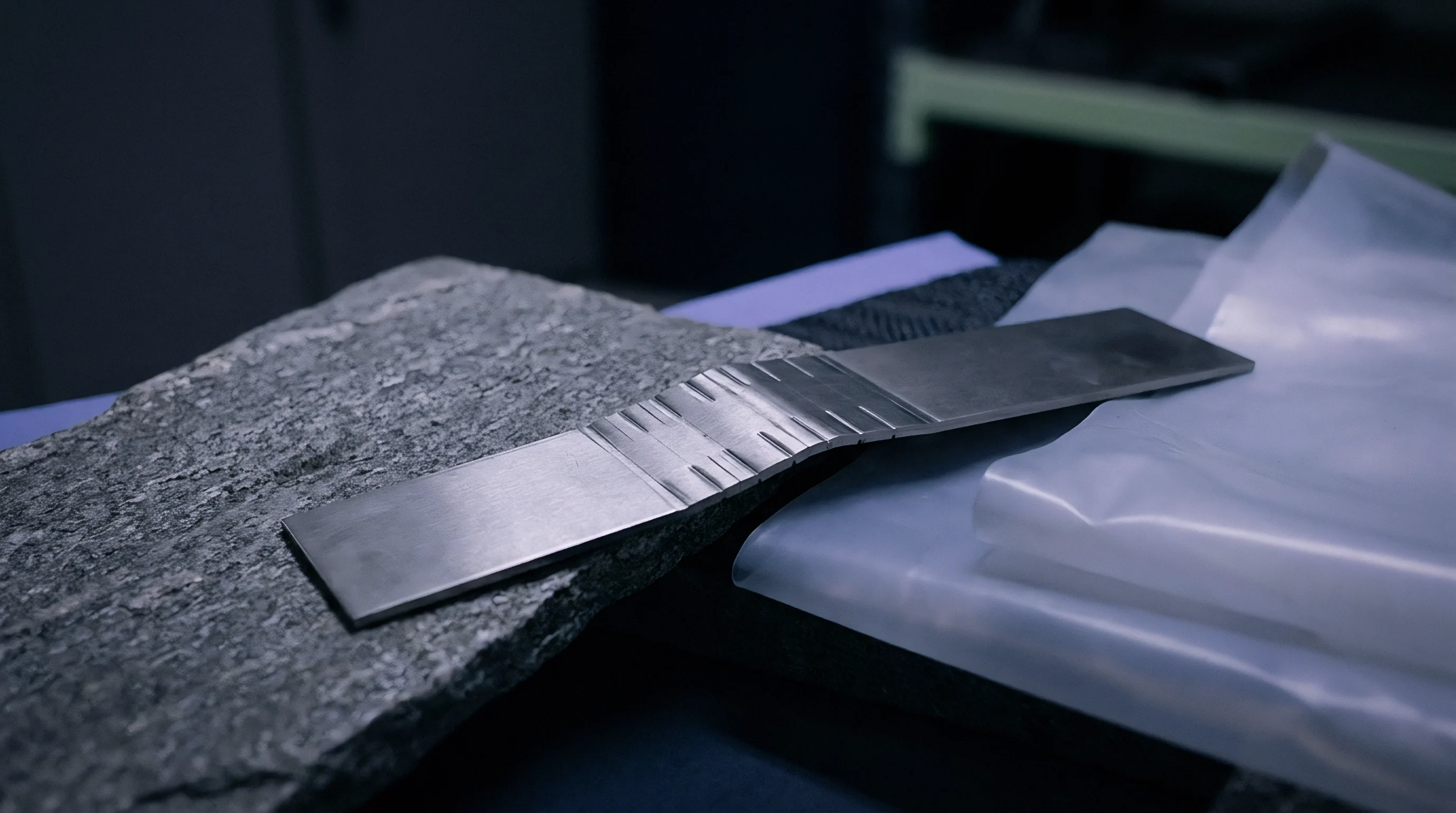
Following shock wave transit and tensile release, an intermetallic target undergoes dynamic cooling through thermal conduction into surrounding unshocked material or containment fixtures. The cooling rate during this stage often exceeds 10⁶ kelvin per second, producing an effective thermal quench. This rapid temperature drop halts long-range vacancy migration while preserving the highly disordered atomic configurations generated under peak shock compression.
The retained point defect population directly dictates the post-shock hardness, residual stress state, and corrosion susceptibility of the recovered intermetallic.
Dynamic temperature spikes associated with adiabatic shock heating depend on the equation of state and peak Hugoniot pressure. A 15-gigapascal shock in Ni₃Al produces an adiabatic temperature rise of approximately 220 kelvin. While insufficient to cause bulk melting, this local thermal surge drastically elevates vacancy jump rates during the brief compressive pulse.
Once the shock pulse dissipates, heat conducts rapidly into adjacent cooler zones. Mobile vacancies that fail to reach grain boundaries or surface sinks during this rapid cooldown become frozen within the ordered superlattice as trapped non-equilibrium point defects.
Residual anti-site defect concentrations remain exceptionally high in shock-quenched intermetallics. In stoichiometric B2 FeAl, iron vacancies freeze alongside iron atoms occupying aluminum sites (anti-structure iron). This structural freezing prevents the alloy from restoring long-range chemical order through equilibrium diffusion.
Positron annihilation lifetime spectroscopy of shock-recovered specimens reveals that vacancy concentrations remain up to three orders of magnitude above equilibrium values weeks after shock exposure.
The table below summarizes typical post-shock microstructural parameters observed in 10-gigapascal shock-quenched intermetallic alloys, highlighting the retention of point defects and structural disorder.
| Alloy System | Long-Range Order Parameter (S) | Retained Vacancy Fraction | Dislocation Density (m⁻²) | Microhardness Increase (%) |
|---|---|---|---|---|
| Ni₃Al (Polycrystalline) | 0.82 | 4.5 × 10⁻⁴ | 3.2 × 10¹⁵ | 45 |
| Ti-48Al-2Cr-2Nb (Duplex) | 0.74 | 6.8 × 10⁻⁴ | 7.8 × 10¹⁵ | 68 |
| Fe-40Al (B2 Single Phase) | 0.69 | 1.2 × 10⁻³ | 1.1 × 10¹⁶ | 82 |
| CoTi (B2 Ordered) | 0.88 | 2.1 × 10⁻⁴ | 2.4 × 10¹⁵ | 38 |
These trapped defects introduce substantial localized lattice strains. Stored elastic energy within the vacancy-rich matrix drives anomalous low-temperature recrystallization during subsequent post-impact thermal cycles, permanently altering mechanical performance.
Engineering components exposed to repeated explosive or hypervelocity impacts accumulate escalating defect concentrations, eventually triggering structural phase shifts without bulk thermal activation.
Yield

Constitutive Modeling of Defect-Mediated Plasticity
Accurate prediction of shock wave attenuation and dynamic failure in intermetallics requires constitutive models that explicitly account for stress-assisted vacancy migration. Standard continuum plasticity formulations, such as the Johnson-Cook or Zerilli-Armstrong models, rely solely on macroscopic strain, strain rate, and bulk temperature. These formulations fail to capture anomalous hardening, shock-induced chemical disordering, and accelerated spall nucleation in intermetallic superlattices because they omit the kinetic contributions of non-equilibrium point defect populations.
Advanced internal state variable models address these limitations by incorporating vacancy concentration and sublattice order parameters directly into the flow stress formulation. The effective flow stress incorporates a thermal shear stress component, an athermal forest dislocation component, and a point defect hardening increment. The evolution equation for the point defect density includes both a dynamic generation term proportional to the plastic work rate and a stress-assisted diffusion loss term governing annihilation at mobile dislocations and grain boundary sinks.
A typical implementation couples the directional vacancy diffusion equation directly to the mechanical momentum balance:
- Mechanical Conservation Equations dictate the instantaneous distribution of density, particle velocity, and stress tensor components across the hydrodynamic computational grid.
- Constitutive Inelasticity Relations calculate plastic strain increments using mobile dislocation densities, taking into account drag-controlled dislocation velocities under high stress.
- Kinetic Defect Evolution Functions determine dynamic vacancy generation rates from the non-conservative motion of jogged screw dislocations across active slip systems.
- Stress-Coupled Diffusion Solvers compute directional vacancy flux using the local gradients of the deviatoric and hydrostatic stress components.
- Equation of State Modifiers adjust the instantaneous bulk modulus and yield threshold according to the updated vacancy concentration and local long-range order parameter.
Implementing these coupled kinetics within hydrocode simulations significantly refines damage predictions. Standard models typically predict smooth, diffuse deformation fields behind shock fronts. Conversely, constitutive models incorporating stress-assisted defect migration capture localized bands of chemical disorder and rapid void nucleation at shock-release interfaces, matching experimental velocity interferometer results.
A technical point of ongoing divergence between modeling groups centers on the exact numerical magnitude of the vacancy formation volume under dynamic shock compression. While molecular dynamics simulations predict a dynamic relaxation volume approaching negative 0.3 atomic volumes for B2 FeAl, classical continuum thermodynamic assumptions hold this value strictly positive. Resolving this discrepancy remains essential for unifying atomistic simulations with macroscopic continuum shock data.
Failure to integrate stress-assisted vacancy migration dynamics into ballistic armor evaluations leads directly to severe overestimations of projectile perforation resistance in advanced intermetallic armor systems.