Stress Assisted Diffusion and Interface Motion under Combined Creep Fields
Multiaxial creep stress fields drive atomic vacancy diffusion across grain interfaces, accelerating boundary cavitation and requiring rigorous dossier verification.


Boundary
High-temperature components under static loads undergo atomic reordering along crystal interfaces. Tensile and compressive creep fields alter chemical potential gradients, driving diffusion across phase boundaries and grain walls. In polycrystalline superalloys and high-chromium ferritic steels operating above 550 degrees Celsius, stress fields force atoms away from interfaces perpendicular to tensile loads.
Vacancies drift in the opposite direction, accumulating on grain boundaries normal to the primary strain axis. This directional transport leads to interface displacement, microstructural coarsening, and failure long before reaching macroscopic yield stress thresholds.
When external loads generate multi-axial stress states inside structural forgings, diffusion rates change significantly. Hydrostatic tension dilates the metallic lattice, lowering the activation energy required for interstitial and substitutional atomic jumps. Deviatoric shear stress distorts crystallographic planes, opening paths that accelerate solute transport along high-angle interfaces.
Factory test certificates reporting only uniaxial creep rupture strength fail to account for this degradation, leaving high-energy industrial plants vulnerable to sudden component cracking during steady-state service.
Atomic Migration Mechanics in Polycrystalline Solids
Sub-surface transport mechanisms respond directly to localized stress gradients during sustained elevated temperature exposure. In a solid solution crystal lattice, an applied stress field modifies local vacancy concentrations. Regions under tensile stress exhibit higher equilibrium vacancy densities than those under compression, creating a thermodynamic driving force for flux through the bulk lattice and along high-density structural paths such as grain boundaries.
ISO 204 testing guidelines demand continuous furnace temperature stability within 1.5 degrees Celsius to prevent thermal gradient fluctuations from masking stress-assisted diffusion rates.
Grain boundary diffusion dominates material transport at low to intermediate homologous temperatures. High-angle boundaries serve as fast-diffusion channels because their atomic packing density is lower than that of the perfect lattice bulk. Under creep conditions, applied shear stress forces grain boundary sliding, generating stress concentrations at triple points and phase boundaries that drive rapid vacancy diffusion toward boundary planes, accelerating cavity nucleation and local shear band formation.
Analyzing stress-assisted interface motion in heat-treated industrial forgings requires the following steps:
- Cut microstructural coupons from both high-stress transition zones and low-stress flange locations of the landed casting.
- Mount and polish the metallographic specimens using diamond suspensions down to 0.05 microns to reveal grain boundary structures without smear deformation.
- Etch the polished surface using chemical reagents appropriate for the specific alloy matrix to highlight secondary phase precipitates along grain interfaces.
- Measure gamma-prime precipitate depletion zone widths adjacent to grain boundaries under field-emission scanning electron microscopy.
- Calculate solute diffusion coefficients by mapping concentration gradients across phase interfaces using electron probe microanalysis.
- Compare measured depletion widths against baseline unaged heat-treatment control samples to quantify creep-induced diffusion rates.

Interfacial Driving Forces under Strain
Chemical energy differentials between adjacent crystal grains shift when applied loads alter local lattice parameters. Applied mechanical strain changes the bulk free energy of neighboring grains according to their crystallographic orientation relative to the principal stress axis. Grains favorably oriented for elastic deformation store less strain energy than misoriented neighbors; this energy density difference acts as a mechanical force that drives the boundary toward the higher-energy grain, consuming it over time.
Precipitate phase stability along boundaries governs interface migration velocity. In nickel-base turbine blade alloys, gamma-prime precipitates pin grain interfaces and resist movement under moderate loads. Sustained elevated temperatures and creep stress fields alter this equilibrium.
Solute atoms diffuse away from strained interfaces, dissolving secondary precipitates or coarsening them into asymmetric directional structures. Once these pinning particles pass critical dimensions, grain interfaces break free, sliding rapidly and accelerating tertiary creep.
Whether localized solute segregation at migrating grain boundaries permanently lowers the activation energy for tertiary creep in polycrystalline superalloys remains a subject of ongoing study.


Coupling
Mechanical stress fields alter the thermodynamic potential of diffusing species across metallic crystal lattices. Chemical potential under combined creep depends on both the concentration gradient and the stress tensor state, with the total driving force equaling the negative gradient of chemical potential. When mechanical strain couples with mass transport, diffusion occurs even without initial chemical concentration gradients, driving solute atoms toward or away from high-stress zones.
In industrial heat exchangers and turbine components, thermal expansion mismatch between matrix phases generates internal micro-stresses that add vectorially to external creep loads. The resulting stress distribution determines whether phase boundaries remain stationary or migrate through the matrix. Misjudging this mechanical-chemical interaction leads to inaccurate remaining-life predictions for high-temperature pressure boundary components.
Hydrostatic Pressure Effects on Atomic Drift
Volumetric expansion within the lattice creates localized energy sinks that attract atomic vacancies. Hydrostatic stress modifies the chemical potential of diffusing vacancies by an amount proportional to stress magnitude and the atomic volume change during vacancy formation. Tensile hydrostatic stress lowers vacancy formation energy, increasing local vacancy concentration and accelerating diffusion flux.
Hydrostatic gradients drive mass transport independently of concentration differences. Where components feature sharp changes in cross-sectional geometry, these gradients reach extreme values: vacancies drift toward points of highest tensile hydrostatic stress while matrix atoms move toward compressed regions. This mass flow creates local density variations, promotes micro-void formation, and shifts internal phase boundaries toward peak stress concentrations.
Consider a nickel-base superalloy forging operating at 750 degrees Celsius under a uniaxial tensile creep stress of 120 MPa combined with a hydrostatic stress component of 40 MPa. Assuming a grain boundary width of 0.5 nanometers, an initial vacancy concentration of 10 to the power of minus six per lattice site, and an average grain size of 50 micrometers, the atomic vacancy diffusion coefficient equals 2.5 times 10 to the power of minus 15 square meters per second under zero stress. Applying the combined stress field lowers the vacancy migration energy via hydrostatic work, raising the effective diffusion coefficient.
The hydrostatic work contribution lowers the activation energy barrier by the product of the hydrostatic stress and the activation volume. Assuming an activation volume equal to 0.7 atomic volumes, the applied hydrostatic pressure increases vacancy jump frequency by a factor of 1.48 at 750 degrees Celsius. Consequently, vacancy flux across transverse grain boundaries increases from 3.1 times 10 to the power of 12 atoms per square meter per second to 4.6 times 10 to the power of 12 atoms per square meter per second.
Over 10,000 hours of continuous service, this elevated flux accumulates a 0.08 percent micro-void volume fraction at grain interfaces normal to the load axis, initiating tertiary creep voiding earlier than standard uniaxial test models predict.
| Stress Component | Primary Driving Mechanism | Impact on Microstructure | Critical Field Manifestation |
|---|---|---|---|
| Hydrostatic Tension | Lattice volume expansion and vacancy energy reduction | Increases vacancy concentration and accelerates cavity nucleation | Void formation at internal notch roots and thick sections |
| Deviatoric Shear | Crystallographic plane distortion and dislocation glide | Forces grain boundary sliding and dynamic recrystallization | Localized shear band formation and interface deformation |
| Stress Gradients | Non-uniform thermodynamic chemical potential fields | Drives directional atomic flux toward low-stress Sinks | Asymmetric solute depletion and local phase destabilization |
| Interfacial Mismatch | Coherency strain energy differences across boundaries | Triggers directional coarsening of strengthening phases | Rafting of gamma-prime precipitates perpendicular to load |

Deviatoric Stress and Phase Transformations
Shear components alter the activation barrier for interstitial solute movement along crystallographic slip directions by rotating crystallographic planes and distorting crystal symmetry. This lowers energy barriers for specific atomic jump directions while raising them for others, producing anisotropic diffusion that alters phase transformation kinetics during aging or creep deformation.
Phase boundaries under shear deformation migrate through atomic shuffling coupled with solute diffusion. In martensitic high-chromium steels, deviatoric stress accelerates the transformation of metastable carbides into coarse equilibrium phases along grain interfaces. Solute atoms such as chromium and molybdenum migrate away from high-shear interfaces, forming alloy-depleted zones vulnerable to intergranular oxidation and localized creep fracturing.
Shifting alloy formulas when manganese or silicon costs fluctuate alters phase boundary stability under creep conditions.
Transverse grains under triaxial stress always fail faster than longitudinal grain boundaries aligned with the primary load axis.
Dynamic recovery occurs alongside creep strain when shear stress drives interface motion through dislocation network absorption. Migrating grain boundaries sweep through strained lattice regions, absorbing stored dislocation density and leaving behind strain-relieved recrystallized grains. This softens the alloy locally, concentrating strain in narrow recrystallized zones and accelerating micro-void formation.

Pore
Sustained tensile stresses at high temperatures promote the coalescence of crystal lattice vacancies into microscopic cavities along grain interfaces normal to the maximum principal tensile stress axis. Stress-assisted diffusion continuously supplies vacancies to expanding cavity tips, driven by stress concentration at the cavity surface.
Intergranular void accumulation is the primary damage mechanism during secondary and tertiary creep stages. As individual cavities expand, they intersect neighboring voids along grain boundary planes, forming planar microcracks. Once these microcracks reach critical length, catastrophic brittle-appearing fracture occurs across component cross-sections without prior macroscopic necking or warning.

Does Multiaxial Creep Strain Accelerate Grain Boundary Sliding?
Transverse shear loading forces adjacent crystal planes to slip past one another along high-angle interfaces where temperature influences vacancy concentration. Grain boundary sliding generates extreme stress concentrations at boundary triple points, ledge steps, and hard intermetallic inclusions. These localized stress peaks exceed the macroscopic tensile load by factors of three to five, creating ideal sites for vacancy condensation and cavity nucleation.
Multiaxial strain fields change the balance between grain interior deformation and interfacial sliding. When principal stress ratios force significant shear deformation along interface planes, sliding rates increase and generate micro-cavities at twice the rate seen in pure uniaxial loading. Evaluating components under combined tension and torsion reveals that cavity growth rates depend strongly on the ratio of hydrostatic stress to equivalent von Mises stress, a behavior standard uniaxial testing fails to capture.
A triaxial creep stress ratio exceeding 1.8 accelerates cavity nucleation along gamma-prime phase boundaries by 340 percent at 850 degrees Celsius.
Plant operators and quality inspectors can use the following checklist to identify intergranular cavitation and microstructural degradation in high-temperature component forgings:
- Interfacial Void Density context requires measuring cavity counts per millimeter of transverse grain boundary on polished cross-sections using backscattered electron imaging.
- Boundary Precipitate Coarsening context demands tracking the average diameter of carbide particles to identify localized solute depletion and loss of boundary pinning strength.
- Micro-Swell Radial Expansion context involves measuring dimensional changes along unmachined forging surfaces to detect internal bulk volumetric cavitation before visible surface cracks appear.
- Triple-Point Ledge Cracking context mandates high-magnification field emission inspection at three-grain intersections to confirm whether shear sliding has initiated stress-concentration voids.
- Solute Depletion Depths context requires energy-dispersive X-ray spectroscopy line scans across phase interfaces to map chromium and aluminum depletion adjacent to cavitated boundaries.
Cavity Nucleation and Coalescence Thresholds
Vacancy clusters reach critical thermodynamic stability when local tensile stress overcomes surface tension forces. The critical radius for stable cavity nucleation decreases as local tensile stress increases, allowing smaller vacancy clusters to survive and grow into macroscopic voids rather than dissolving back into the crystal matrix.
Coalescence begins when the distance between expanding grain boundary cavities falls below two times the cavity radius. At this stage, vacancy diffusion between adjacent cavities accelerates as stress fields around neighboring void tips interact. As precipitate coarsening weakens interface strength, the effective load-bearing area of the grain boundary drops rapidly, causing localized stress spikes that drive final tertiary creep failure.
Neglecting hydrostatic tension during multiaxial stress calculations results in unexpected rupture prior to scheduled overhaul intervals, causing forced outage expenses that dwarf initial forging costs.
Bench
Laboratory creep testing reports provide the empirical foundation for predicting component life in high-temperature industrial environments. Test specimens must endure thousands of hours under controlled mechanical loads and elevated thermal conditions to yield reliable deformation and rupture data. Misinterpreting laboratory results or accepting incomplete testing dossiers introduces severe operational risks into heavy equipment procurement.
Raw stress-rupture figures reported by overseas suppliers often hide critical variations in test execution. Small shifts in test bench alignment, thermal gradient control, or extensometer calibration distort strain rate measurements significantly. Buyers must examine raw test logs and post-test metallographic reports to verify that recorded material capabilities match actual physical behavior.

Stress-Rupture Dossier Verification Rules
Engineers audit factory creep strain records against continuous temperature logs and extensometer calibration data, taking into account how heat treatment alters grain alignment. Standard stress-rupture trials report total time to rupture under a single static load, but often omit detailed minimum creep rate calculations. Without precise creep rate records, predicting long-term structural deformation under variable plant operating cycles is impossible.
Factory certificates should be cross-referenced with accredited third-party laboratory audits. Suppliers sometimes re-use stress-rupture data sheets across multiple forging heats or extrapolate short-term 100-hour test results out to 10,000-hour design life guarantees using invalid linear scaling factors. Verification requires continuous digital strain-time data points recorded at intervals no greater than fifteen minutes throughout the entire duration of the creep test.
Factory certificates that omit transverse strain measurements during stress-rupture trials hide premature intergranular separation.
| Test Parameter | Standard ASTM E139 Requirement | Rigorous Purchasing Dossier Mandate | Operational Failure Risk |
|---|---|---|---|
| Temperature Uniformity | Within +/- 3 degrees Celsius along gage length | Within +/- 1.0 degrees Celsius continuous digital log | Thermal gradients drive non-uniform creep diffusion and localized necking |
| Axial Alignment | Bending strain under 10 percent of axial strain | Bending strain under 3.0 percent verified before heating | Parasitic bending stresses accelerate grain boundary sliding and early voiding |
| Data Capture Rate | Periodic manual or digital strain recording | Continuous digital capture at maximum 15-minute intervals | Misses secondary-to-tertiary creep transition point and strain acceleration |
| Post-Test Metallurgy | Optional visual specimen inspection | Mandatory SEM grain boundary cavitation and precipitate analysis | Conceals premature intergranular creep fracture modes under nominal strain limits |

Multiaxial Creep Test Rig Design Requirements
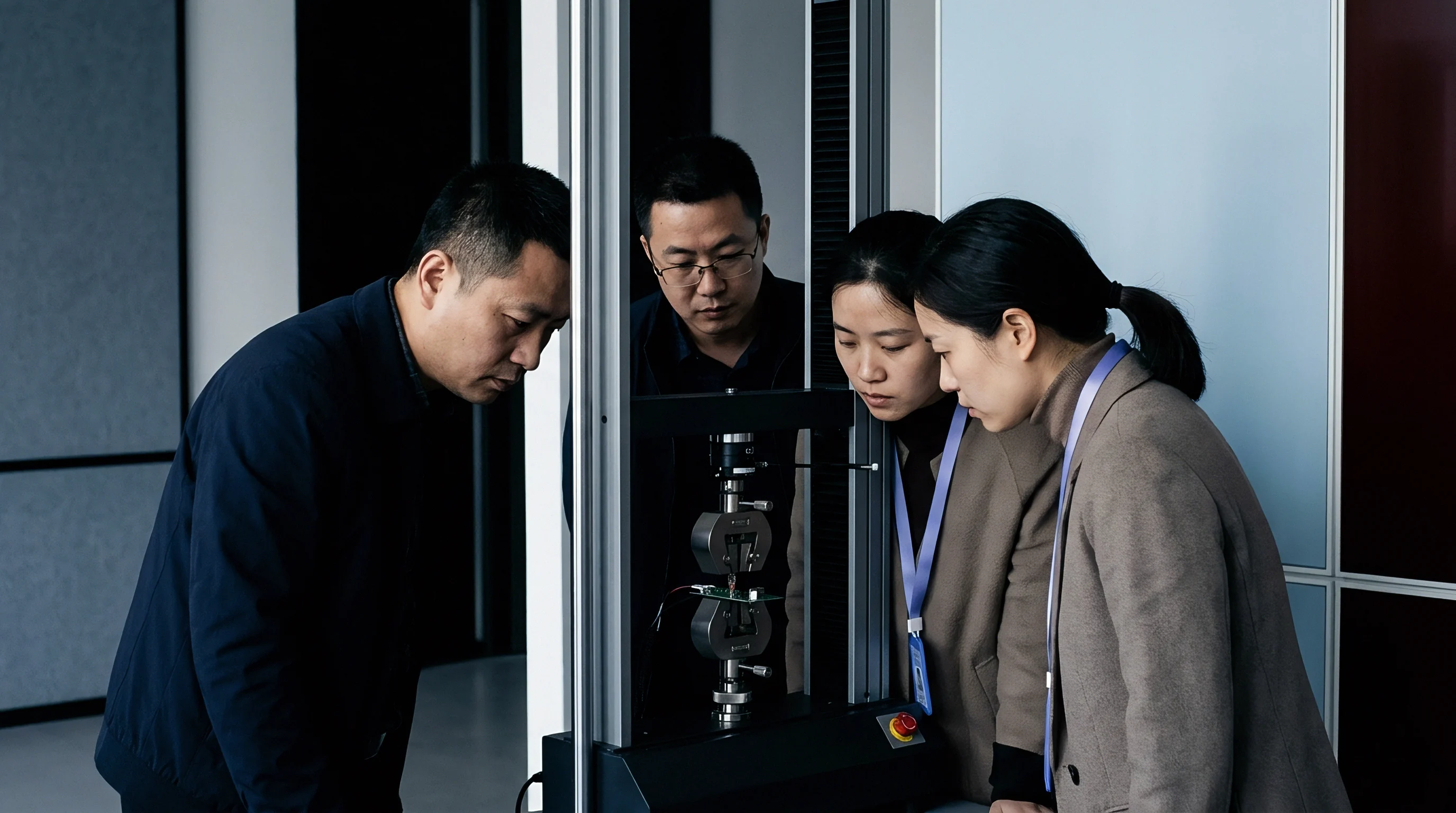
Standard uniaxial tension frames fail to capture the complex stress states present in actual turbine components, where strain rates dictate failure modes. Advanced testing facilities utilize cruciform specimen frames or pressurized thin-walled tubular rigs capable of applying combined axial tension, hoop stress, and internal torsion simultaneously. These multiaxial test frames reveal how complex stress fields alter atomic transport rates and grain boundary migration kinetics in full-scale forgings.
Rig alignment and load frame rigidity directly determine experimental reliability. Off-axis bending loads introduced by misaligned grips create parasitic shear stresses across specimen gage lengths, causing artificial grain boundary sliding and falsely elevated diffusion rates. Test benches require active spherical alignment seats and multi-axis optical extensometers to record true multi-directional strain fields during multi-thousand-hour creep exposures.
Validating high-temperature alloy creep resistance dossiers prior to accepting component shipments requires the following technical documents:
- Continuous Thermal Calibration Logs context requires continuous multi-channel thermocouple records proving furnace temperature stability within strict tolerance limits throughout test duration.
- Raw Strain-Time Data Matrices context demands full digital data sets containing time-stamped extensometer readings from initial elastic loading through final specimen rupture.
- Pre-Test Heat Treatment Dossiers context involves detailed solution annealing and aging furnace records showing precise soak times, quench media rates, and temperature profiles.
- Post-Rupture SEM Micrographs context mandates high-resolution electron imaging of the fracture surface and sectioned gage length showing intergranular void densities and failure modes.
- Third-Party Calibration Certificates context requires current accreditation records for load cells, extensometers, and furnace control instrumentation from recognized metrology bodies.
Minor temperature spikes during hundred-hour stress-rupture trials fall within standard furnace control tolerances and exert no measurable effect on final microstructural stability.

Overhaul
Component lifetime assessments in power plants rely on non-destructive evaluation of microstructural creep damage. Field-run turbine rotors, piping headers, and chemical reactor vessels accumulate stress-assisted diffusion damage over decades of operation. Quantitative metallographic replication and ultrasonic velocity testing allow engineers to measure intergranular cavity density without destroying expensive components.
Retirement decisions require balancing remaining structural capability against the massive capital expense of new forgings. When replication reveals widespread grain boundary cavitation or precipitate coarsening, component life has entered the tertiary creep phase. Operating equipment beyond this boundary risks catastrophic structural bursting, facility destruction, and severe danger to personnel.
Remanufacturing and Service Life Decisions
Maintenance managers evaluate microstructural coarsening against dimensional tolerances before authorizing rotor re-machining. Skimming degraded surface layers off heat-damaged forgings removes localized creep cracks, but because triaxial tension accelerates cavity nucleation deeper in the matrix, it fails to restore internal lattice damage caused by bulk vacancy diffusion. Re-machined components operating under high-temperature creep fields exhibit shorter residual service lives than newly manufactured units.
Field repair welds introduce severe stress concentrations and local chemical gradients into creep-exposed alloys. Weld heat-affected zones contain narrow bands of varying grain sizes and precipitate distributions. Under operational creep loads, stress-assisted diffusion concentrates vacancies within the coarse-grained heat-affected zone interface, triggering premature creep cracking known as Type IV intergranular failure.

Procurement Warranties and Liability Allocation
Supply contracts for high-temperature forgings assign financial responsibility for early field failures to the raw material foundry. Because creep deformation alters local chemistry, warranties must extend beyond basic dimensional compliance to guarantee specific microstructural resistance parameters under combined stress fields. Including explicit metallographic acceptance criteria within purchase orders protects buyers from absorbing early failure expenses.
Procurement specifications should mandate that raw material suppliers retain archive coupons from every production heat for ten years. If a component suffers premature creep rupture in service, independent laboratories re-examine these archived samples to determine whether microstructural defects originated during factory heat treatment or resulted from abnormal operational stress spikes.
Standard procurement contracts under ASTM A336 mandate that forgings exhibiting grain boundary cavitation during post-test metallographic sectioning undergo immediate rejection without supplier credit.