Dynamic Thermal Humidity Chamber Protocol Design for Polymer Viscoelastic Stress Relaxation
Dynamic hygrothermal stress relaxation testing demands simultaneous vapor pressure control and compliance-free strain fixtures to construct valid polymer master curves.
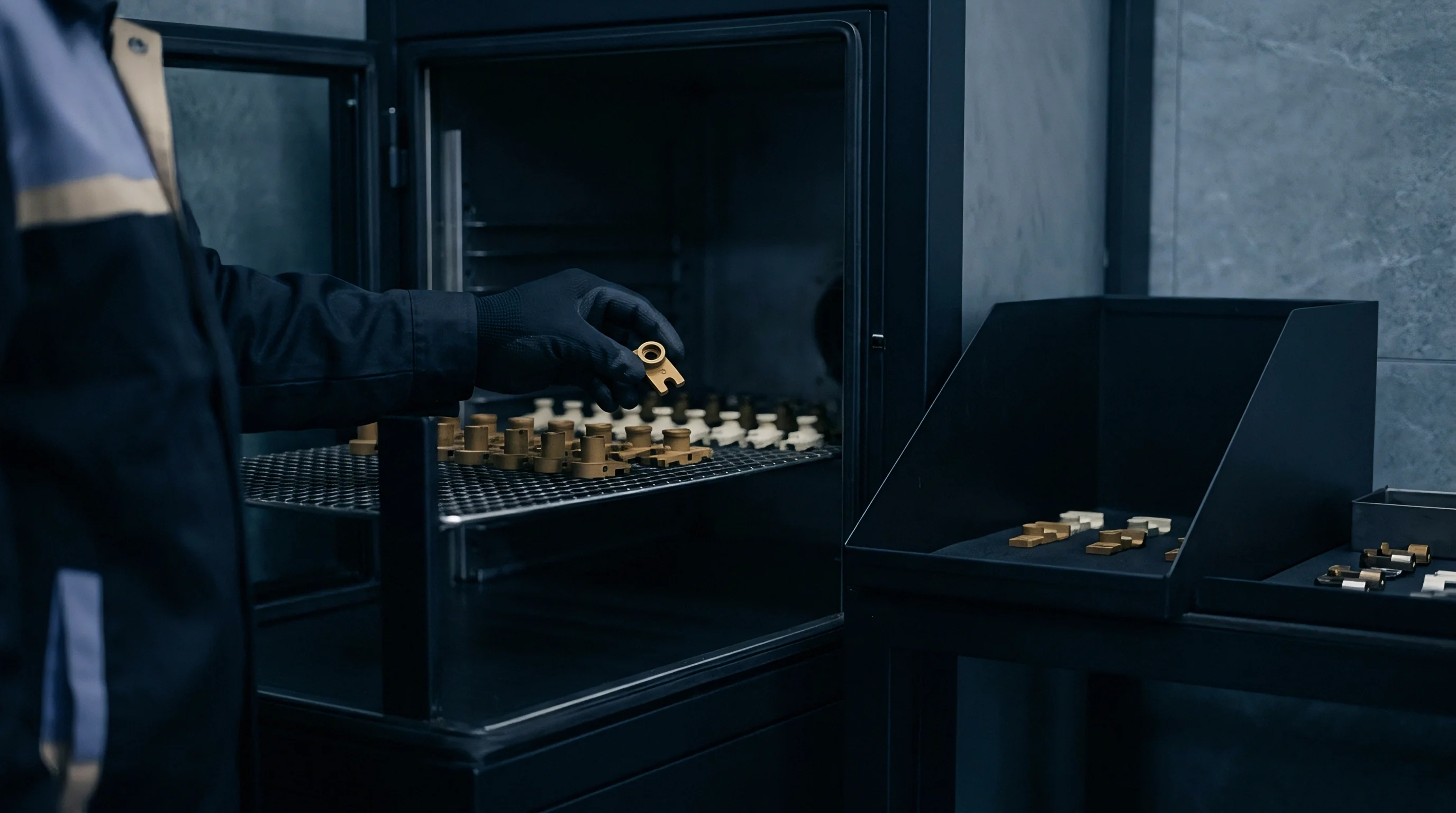

Swell
Polymer matrices subjected to concurrent moisture vapor and thermal cycling experience severe shifts in chain mobility. Water molecules penetrating a glassy or semi-crystalline polymer act directly as plasticizers, interrupting inter-chain hydrogen bonding and expanding the unoccupied volume within the amorphous phase. In polyamides such as nylon 66, every one percent increase in absorbed moisture by weight lowers the glass transition temperature by roughly twenty to twenty-five degrees Celsius.
This drop shifts the material’s viscoelastic response spectrum, causing stress relaxation rates at thirty degrees Celsius and eighty percent relative humidity to match the rapid decay kinetics normally observed at seventy degrees Celsius under completely dry conditions.
Designing dynamic thermal-humidity stress relaxation procedures demands complete separation between purely thermal viscoelastic decay and hygroscopic volume expansion. When a polymer specimen absorbs moisture under fixed boundary strain, isotropic swelling generates internal compressive stress increments that superimpose onto the relaxing tensile force vector. The load cell records a composite force decay curve combining true viscoelastic stress relaxation, moisture-induced plasticization kinetics, and swelling-induced force offsets.
Failure to decouple these simultaneous phenomena distorts the calculated relaxation modulus by orders of magnitude over extended temporal scales.
Absorbed water molecules screen intermolecular hydrogen bonds, accelerating polymer chain mobility during constant strain exposure.

Hygroscopic Plasticization and Free Volume Expansion
Water absorption within polar polymers proceeds through dual-mode sorption mechanics combining Langmuir site-binding and Fickian free-volume filling. At low relative humidity levels, water molecules bind preferentially to polar functional groups, such as the amide links in polyamides or hydroxyl groups in epoxy systems. As relative humidity increases beyond forty percent, water molecules cluster within the polymer matrix, driving non-linear volumetric expansion.
This volumetric expansion directly alters the fractional free volume available for segmental chain motion, shifting the mechanical relaxation time spectrum toward shorter durations.
When testing viscoelastic stress relaxation under dynamic humidity profiles, the rate of water vapor ingress governs the instantaneous compliance of the test specimen. A thin polymer film reaches moisture equilibrium rapidly, whereas a three-millimeter thick injection-molded tensile bar establishes steep internal moisture concentration gradients during transient relative humidity steps. The outer core of the specimen plasticizes and relaxes immediately, while the dry interior core maintains high stiffness and bears the majority of the applied load.
Consequently, raw stress relaxation data collected during transient humidity exposure reflects spatial geometric non-uniformity rather than an intrinsic material property.
Non-Equilibrium Moisture Diffusion during Relaxation Testing
Accurate protocol design establishes explicit conditioning criteria based on Fickian diffusion kinetics. The characteristic time for moisture equilibration scales with the square of specimen thickness divided by the concentration-dependent diffusion coefficient. For a polyimide sheet with a thickness of one millimeter and a moisture diffusion coefficient of ten to the minus eighth square centimeters per second, achieving ninety-five percent saturation requires tens of hours of uninterrupted exposure at target temperature and relative humidity levels.
Initiating mechanical strain prior to achieving true moisture equilibrium introduces non-equilibrium stress relaxation behavior. As water continues to diffuse inward during the constant-strain test, the effective modulus of the interior core decays continuously, accelerating the measured force drops beyond what isothermal, isohume viscoelastic relaxation models predict. Protocol design must enforce strict weight-gain stabilization checks prior to strain application.
Uncompensated hygroscopic strain in load-bearing nylon seals produces catastrophic clamping force decay within six months of field deployment.

Grip
Mechanical loading frames operating inside environmental enclosures face severe parasitic force artifacts. As ambient chamber temperatures step from ambient to elevated levels, steel loading rods, grip jaws, and drive couplings expand linear dimensions according to their respective thermal expansion coefficients. A standard stainless steel pull rod assembly spanning four hundred millimeters inside a testing enclosure undergoes an axial expansion of roughly seventy-two micrometers when heated across a forty-degree Celsius increment.
If the test protocol specifies a fixed specimen strain of one percent on a fifty-millimeter gauge length, a seventy-two micrometer fixture expansion relieves the specimen strain by one point four four percent, causing an artificial drop in recorded load that mimics true polymer stress relaxation.
Minimizing parasitic fixture effects requires careful structural material selection and rigid mechanical design. High-nickel alloys such as Invar 36 exhibit thermal expansion coefficients below one point two times ten to the minus sixth per degree Celsius, reducing fixture compliance distortion by more than eighty-five percent compared to standard series-300 stainless steels. Furthermore, mechanical clamps must maintain constant force on the specimen ends throughout the testing cycle.
Polymer specimens undergo cross-sectional Poisson contraction during initial strain application and secondary volume shrinkage during thermal drying cycles, causing conventional mechanical screw grips to lose clamping pressure and allow micro-slippage at the interface.
A thermal expansion mismatch of twelve micrometers between metallic fixtures and polymer specimens introduces artificial stress decay exceeding fourteen percent during initial relaxation steps.
Quantifying Thermal and Compliance Distortion in Fixture Assemblies
Evaluating the mechanical compliance of the load train involves subjecting an ultra-stiff calibration specimen, such as a hardened Invar bar, to the exact thermal-humidity trajectory specified for the polymer evaluation protocol. The resulting force-displacement profile isolates the environmental response of the load cell, pull rods, and clamping interfaces. Subtracting this baseline fixture compliance curve from raw polymer stress relaxation datasets isolates true material behavior.
Consider a practical comparison between standard stainless steel 316 fixtures and low-expansion Invar 36 fixtures under a severe hygrothermal step protocol. Assume a polymer test specimen with an initial elastic modulus of two point five gigapascals, a cross-sectional area of ten square millimeters, a gauge length of fifty millimeters, and an applied initial strain of one point five percent, corresponding to an initial applied force of three hundred seventy-five newtons. The chamber undergoes a temperature jump from twenty-three degrees Celsius to eighty-five degrees Celsius at eighty percent relative humidity.
Table data below highlights the parasitic strain decay caused by fixture thermal expansion.
- Thermal mass misalignment creates transient temperature gradients across specimen thickness during rapid chamber heating cycles.
- Clamp bolt relaxation reduces clamping pressure on low-friction polymers, allowing micro-slippage that corrupts load decay decay slopes.
- Transducer thermal drift introduces uncompensated strain offset when humidity alters load cell bridge bridge balancing.
- Hygroscopic seal expansion exerts extraneous lateral forces against the pull rod passing through chamber insulation walls.

Strain Transducer Selection and Moisture Isolation
Direct strain measurement on the specimen gauge length eliminates pull rod compliance errors but introduces sensor protection challenges. Contacting extensometers can gouge soft plasticized polymer surfaces or exert parasitic spring forces that alter stress decay slopes. Non-contact optical video extensometers remove mechanical loading completely but face optical window fogging and refractive index fluctuations caused by thermal-humidity turbulence inside the chamber enclosure.
When using internal linear variable differential transformers or load cells inside high-humidity environments, hermetic sealing and active thermal compensation become mandatory. Moisture ingress into unsealed strain gauge bridges alters electrical insulation resistance, inducing zero-point drift that corrupts long-term relaxation measurements spanning days or weeks. External load cells located outside the environmental enclosure avoid humidity exposure but require frictionless, sealed rod penetrations through the chamber wall, using hydrophobic fluoropolymer bellows or air bearings to eliminate rod friction forces.
Early load decay often stems from thermal expansion within steel clamping assemblies rather than specimen seating, though test reports frequently attribute it to the latter.


Chamber
Environmental testing enclosures control dry-bulb temperature and vapor pressure simultaneously to prevent transient surface condensation during dynamic thermal transitions. Dew point stability controls vapor pressure. Standard thermal chambers relying on basic steam injection fail to control relative humidity during rapid cooling phases, because air cooling rates often exceed vapor condensation rates, driving the localized relative humidity at the specimen wall to one hundred percent. liquid water droplets depositing onto a stressed polymer specimen induce localized stress corrosion cracking, plasticizer leaching, or rapid non-uniform swelling.
Advanced hygrothermal protocol execution requires dual-dew-point gas mixing systems or controlled steam boiler injection paired with active refrigeration dehumidification. By controlling the saturation temperature of incoming gas streams independently from the dry-bulb temperature of the testing chamber, precision enclosures hold relative humidity stability within plus or minus one percent across operating temperatures ranging from ten degrees Celsius to ninety-five degrees Celsius. This level of psychrometric control guarantees that observed shifts in polymer stress relaxation stem purely from programmed hygrothermal states rather than uncontrolled chamber fluctuations.

Psychrometric Control Mechanics and Sensor Degradation
Relative humidity measurement inside dynamic testing chambers relies on either capacitive thin-polymer sensors or chilled-mirror optical hygrometers. Capacitive sensors offer fast response times but suffer from calibration drift when exposed to high temperature, high humidity environments for extended periods. Water vapor absorption permanently alters the dielectric constant of the sensing polymer layer if contaminants or plasticizers leach out of the test specimens and deposit onto the sensor element.
Chilled-mirror hygrometers provide primary standard accuracy by measuring the exact temperature at which dew forms on a thermoelectrically cooled mirror surface. Although inherently drift-free, chilled-mirror systems require clean chamber air streams, as outgassed polymer additives or volatile plasticizers condense on the optical mirror, triggering false dew point readings. Protocol design must specify periodic sensor verification and purge air cycles to maintain psychrometric measurement integrity throughout long-term stress relaxation exposures.
Capacitive relative humidity sensors degrade rapidly when exposed to saturated vapor cycles above eighty-five degrees Celsius.
How Does Humidity Transition Speed Alter Non-Equilibrium Moisture Gradients?
Steep humidity transition ramps create complex internal stress states within thick polymer specimens. When a chamber steps from ten percent to eighty percent relative humidity at two percent per minute, the exterior boundary layers of the polymer absorb moisture rapidly and attempt to expand. The dry interior core resists this expansion, placing the surface layers in triaxial compression while pulling the interior core into tension.
These self-equilibrating residual stresses combine non-linearly with applied external tensile loads, altering the apparent stress relaxation decay rate during the transition window.
To avoid non-equilibrium stress artifacts, test protocols enforce step-and-hold hygrothermal profiles. The chamber reaches target temperature and humidity levels, followed by an extended dwell period allowing complete moisture diffusion throughout the specimen thickness before the mechanical drive applies initial strain. The numbered operational procedure below defines the correct sequence for initiating hygrothermal stress relaxation evaluations.
- Stabilize the dry-bulb temperature inside the test enclosure at the target setpoint for sixty minutes prior to humidity introduction.
- Ramp relative humidity at a maximum rate of two percent per minute to prevent surface condensation on the specimen load frame.
- Maintain isothermal and isohume conditioning until specimen weight gain remains below zero point zero five percent over four consecutive hours.
- Apply the pre-selected mechanical strain increment within two hundred milliseconds using a closed-loop servo-hydraulic drive.
- Record stress decay continuously at sampling frequencies above ten Hertz during the initial logarithmic decay phase.
| Injection Technology | RH Control Band (%) | Step Response Time (min) | Dynamic Temperature Tracking | Sensor Contamination Risk |
|---|---|---|---|---|
| Boiler Steam Generator | +/- 2.5 | 12 to 18 | Moderate condensation risk during rapid cooling | Low risk to dry bulb sensors |
| Ultrasonic Atomizer | +/- 4.0 | 5 to 8 | High droplet deposition risk on cold fixtures | High mineral deposit risk without deionized water |
| Dual-Dew-Point Gas Mixer | +/- 0.8 | 15 to 25 | Superior stability during isothermal transitions | Negligible contamination in closed loop |
The physical threshold where localized moisture gradients invalidate standard linear shift factor equations under high-amplitude relative humidity steps remains actively disputed across research groups.

Shift
Constructing long-term stress relaxation predictions from short-term experimental data demands mathematically rigorous superposition methodology. Master curves require continuous slope continuity. Free volume expansion drives shift factors.
Time-Temperature Superposition (TTS) expands time scales by shifting short-term relaxation modulus curves collected at elevated temperatures along the logarithmic time axis relative to a reference temperature. When relative humidity enters as a variable parameter, Time-Temperature-Humidity Superposition (TTHS) incorporates moisture-induced shift factors, constructing a unified master curve spanning decades of operational service life.
The total horizontal shift factor, a_total, combines a thermal shift factor, a_T, and a moisture shift factor, a_RH. The mathematical relationship follows a multiplicative formulation in real time, converting to an additive logarithmic relation: log(a_total) = log(a_T) + log(a_RH). The thermal shift factor above the dry glass transition temperature typically follows the Williams-Landel-Ferry (WLF) equation, whereas the moisture shift factor utilizes a modified free-volume expression or an Arrhenius-type moisture activation energy model.
Applying these shift factors enables engineers to predict fifty-year stress retention in underground polymer conduits using two-week accelerated laboratory test datasets.
ISO 18437 mandates explicit validation of vertical scale factors before horizontal shift factor superposition is applied to hygrothermal stress relaxation data.
Mathematical Formulation of Hygrothermal Master Curves
The moisture shift factor, a_RH, relates directly to the change in absorbed moisture concentration relative to a dry reference state. A common empirical model expresses log(a_RH) as negative beta_RH multiplied by the difference between test humidity and reference humidity, where beta_RH represents the moisture shift coefficient. For polar polymers, beta_RH varies between zero point zero two and zero point zero six per percent relative humidity shift, indicating that a fifty percent increase in relative humidity shifts the relaxation time spectrum by one to three orders of magnitude along the time domain.
Constructing a valid master curve requires smooth overlap between adjacent stress relaxation segments. If segments collected at differing temperature and humidity levels display slope discontinuities or fail to overlap along their adjacent ends, the underlying assumption of thermorheological and hygrorheological simplicity breaks down. Thermorheological complexity occurs when different molecular relaxation mechanisms, such as primary alpha-relaxations and secondary beta-relaxations, exhibit different temperature and humidity dependencies, preventing the use of a single horizontal shift factor across the entire temporal window.
- Reference state selection establishes fixed baseline temperature and humidity values from which all master curve transformations originate.
- Vertical modulus scaling corrects for density and entropic elasticity changes caused by temperature and moisture swelling.
- Smoothness overlap criteria verify that adjacent stress relaxation curves maintain identical slope derivatives across transition zones.
- Arrhenius domain verification confirms whether thermal activation energies remain constant above and below the wet glass transition point.
| Polymer Matrix | Glass Transition Dry (deg C) | Glass Transition Sat (deg C) | WLF Constant C1 | WLF Constant C2 (deg C) | Moisture Shift Coefficient beta_RH |
|---|---|---|---|---|---|
| Polyamide 66 (PA66) | 75 | 5 | 17.4 | 51.6 | 0.048 |
| Polycarbonate (PC) | 145 | 138 | 15.2 | 48.1 | 0.005 |
| Polyetheretherketone (PEEK) | 143 | 139 | 12.8 | 55.3 | 0.002 |
| Epoxy Structural Resin | 120 | 85 | 16.1 | 47.2 | 0.022 |
Vertical Scaling and Entropic Modulus Corrections
Horizontal curve shifting alone neglects the direct effect of temperature and water sorption on the instantaneous rubbery or glassy modulus of the polymer. As temperature increases, the entropic spring stiffness of rubbery polymer networks increases proportionally with absolute temperature. Conversely, moisture absorption reduces the density of the material and lowers the instantaneous modulus by swelling the matrix volume.
Vertical shift factors, b_T and b_RH, correct for these structural changes before horizontal alignment proceeds. The vertical adjustment scales raw relaxation modulus values by the ratio of reference density and temperature to test density and temperature. Skipping vertical scaling introduces systematic slope errors into the final master curve, leading to overestimation of long-term load-bearing capacity in structural polymer components exposed to humid outdoor environments.
ASTM E328 Section 8.4 mandates separate verification of thermal and moisture shift factor components prior to combining them into a unified hygrothermal master curve.
Audit
Contract testing facilities in major manufacturing hubs frequently present interpolated stress relaxation curves rather than raw transducer readings. Interpolated data conceals sensor drift. Baseline shifts ruin long-term extrapolation.
Unfiltered signals show raw transducer noise. Overseas buyers commissioning material qualification at third-party Chinese laboratories often receive neatly formatted spreadsheets containing smooth exponential decay curves. When auditing these facilities in person, technical representatives frequently uncover uncalibrated load cells, disabled humidity sensors, or manual deletion of noisy baseline data generated during initial thermal equilibrium phases.
Verifying testing integrity demands access to unedited time-series data files containing raw millivolt transducer outputs, real-time chamber dry-bulb and wet-bulb sensor readings, and raw strain channel inputs. A legitimate test dossier includes timestamped calibration logs for both load frame transducers and chamber psychrometric controls, proving that calibration occurred immediately prior to test initiation under identical hygrothermal conditions.
Raw load cell time-series data reveals uncompensated baseline drift that filtered summary reports obscure.
Field Inspection Protocols for Overseas Laboratory Oversight
Auditing a contract laboratory requires walking the floor during active test execution. Inspectors inspect the routing of pull rods through chamber insulation walls, verify the presence of active cooling jackets on external load cells, and check that deionized water supply lines feeding chamber vapor generators maintain low conductivity levels below two microsiemens per centimeter. Mineral-laden tap water used in steam boilers deposits calcium scale on chamber walls and sensor surfaces, degrading humidity control accuracy within weeks of continuous operation.
Commercial contracts must tie testing milestones to rigorous data delivery standards. Requiring raw data submission at logarithmic time intervals allows foreign engineering teams to run independent baseline validation scripts, detecting artificial curve smoothing or mathematical manipulation before accepting qualification dossiers. Table 3 outlines critical laboratory audit failure modes and their associated commercial impacts.
| Audit Parameter | Observed Field Defect | Technical Root Cause | Commercial Exposure |
|---|---|---|---|
| Strain Control Integrity | Crosshead displacement used instead of gauge extensometry | Missing non-contact optical sensors or frame compliance software | Acceptance of compliant materials that fail in service |
| Psychrometric Logging | Constant RH reported despite 10% thermal spikes | Sensors placed in inlet ducting rather than specimen zone | Invalid master curves leading to product recall risks |
| Raw Data Delivery | Polynomial curve fits provided without raw time-series | Manual filtering of load cell thermal drift artifacts | Inability to defend regulatory compliance dossiers |
| Methodology Note: Audit parameters derived from field evaluations across industrial contract testing facilities in Guangdong and Zhejiang provinces. | |||
Economic Optimization of In-House versus Outsources Qualification
Deciding between establishing internal hygrothermal testing capabilities or outsourcing to third-party contract laboratories involves balancing capital expenditure against execution risks. High-precision dynamic thermal-humidity chambers equipped with low-expansion Invar fixtures and non-contact video extensometers require initial capital outlays exceeding one hundred fifty thousand US dollars per test station. Furthermore, maintaining specialized operational expertise across multi-week test routines adds significant ongoing overhead costs.
However, outsourcing introduce hidden costs stemming from delayed defect discovery, travel expenses for technical audits, and commercial disputes over invalid data. A single product failure in the field caused by corrupted stress relaxation predictions can incur millions of dollars in warranty claims and brand damage. Establishing a hybrid oversight model, where initial screening occurs at certified contract facilities while final master curve validation runs on dedicated, audited in-house test frames, achieves an optimal balance between capital efficiency and technical rigor.
Engineers auditing cross-border test data cross-reference raw timestamp logs against chamber humidity sensor traces to confirm complete moisture equilibrium before accepting relaxation rate slopes.