Preventing Factory Retention Claims over Customer Owned Injection Moulds
Preventing factory retention over customer injection moulds demands PRC fapiao tax invoices, steel asset stamping, and pre-suit court preservation clauses.
Lien
Chinese component manufacturers routinely rely on physical possession of injection moulds as leverage when commercial relationships break down. When a buyer decides to shift production to another vendor, the incumbent supplier will often refuse to release customer-owned tooling, citing unpaid invoices, unapproved engineering change fees, or unamortized setup costs. Operations directors quickly find that ownership clauses on paper mean little at the factory gate if the supplier will not clear logistics vehicles to load the steel.
The statutory basis for these hold-ups sits in Chinese property law. Under Article 447 of the PRC Civil Code, a creditor in lawful possession of a debtor’s movable property may retain that property until overdue enterprise obligations are settled. Component suppliers use this rule to turn standard contract claims into de facto asset seizures, arguing that unpaid part shipments or shortfalls against minimum order commitments give them a direct lien over every mould on the shop floor.
Article 448 of the Civil Code places an important restriction on this right: the retained property must arise from the same underlying legal relationship as the debt, except in certain purely commercial dealings. If tooling bailment and component procurement are governed by distinct agreements, the factory loses its legal ground for tying part invoices to mould possession. In practice, suppliers try to blur this line by folding tooling costs into piece prices or billing maintenance through ordinary purchase orders.
Physical control creates a steep asymmetry. Building and qualifying a replacement multi-cavity tool takes capital, precision machining, and months of sampling, during which downstream lines risk shut-down and buyers face steep customer penalties. Because the operational cost of halted production escalates immediately, retaining the physical steel gives a molder commercial leverage out of all proportion to the disputed balance.
| Retention Trigger Claimed by Molder | Statutory Provision Under PRC Law | Legal Threshold Required for Enforcement | Contractual Defense Position |
|---|---|---|---|
| Unpaid Component Production Invoices | PRC Civil Code Article 447 | Overdue liquidated debt arising directly from component supply contract | Dual-contract structure isolating bailment from piece-part procurement |
| Unrecoupable Tooling Modification Costs | PRC Civil Code Article 448 | Written engineering change order signed by buyer with agreed pricing | Mandatory signed quotation prerequisite clause for design changes |
| Unamortized Setup and Storage Overhead | PRC Civil Code Article 457 | Proven enterprise debt connected directly to physical custody obligations | Explicit zero-storage-fee bailment clause with prepaid maintenance terms |
| Minimum Order Volume Deficit Claims | PRC Civil Code Article 447 | Enforceable breach of contract judgment establishing quantified monetary debt | Exclusion of asset retention rights for unliquidated damages claims |
Moulders also exploit difficulties around proving title on short notice. When a buyer demands its tooling back, the supplier will demand official proof of ownership. China has no central public registry for movable industrial assets like moulds, and local market regulators or Public Security Bureaus generally view these disputes as private contractual matters.
Unless a buyer arrives with a court preservation order or indisputable proof of title, local officials will rarely intervene to force a turnover.
Suppliers often spend months laying the documentary groundwork for a lien. A factory might issue unrequested invoices for warehouse storage, routine maintenance, replacement core pins, or hot runner servicing. If the foreign buyer leaves these notices unanswered, the molder enters the silent records into evidence before a local court as uncontested commercial debt, satisfying the statutory threshold for retaining the property.
The statutory notice period under Article 453 of the PRC Civil Code grants debtors a minimum of two months to fulfill obligations before a lienholder secures the legal right to liquidate retained assets.
Preempting a retention claim means cutting off the supplier’s statutory arguments before the first purchase order is cut. If the contract separates part supply from equipment bailment, the legal connection between part debts and mould custody breaks down. The supply structure must establish clear legal title, unambiguous physical markings, and an explicit bar against cross-default claims.
Standard Western procurement templates consistently fall short in Chinese manufacturing disputes. Foreign purchase orders treat ownership as self-evident, but Chinese courts interpret statutory retention strictly and look for specific local documentation to override a supplier’s possessory lien.
- Bundled Payment Structures allow factories to claim partial ownership of mold steel when tooling costs are amortized inside piece prices over multi-year production runs.
- Silent Invoicing Practices create presumed enterprise debt when molder storage fees or maintenance quotes remain unrejected by buyer procurement teams.
- Missing Asset Serialization prevents Chinese enforcement officers from identifying specific mold plates, cores, and cavity blocks during repossession actions.
- Combined Supply Contracts merge tooling bailment terms into general component manufacturing agreements, enabling statutory enterprise liens under Article 448.
- Unsigned Engineering Changes supply factories with plausible grounds to claim unpaid modification debts over core and cavity modifications.
When these boundaries are not established upfront, disputes rapidly freeze operations. A vendor holding active tooling can halt finished-goods deliveries in forty-eight hours, while litigating a possessory lien through the Chinese court system typically drags on for eight to fourteen months. By the time a judgment arrives, the revenue lost to missed delivery windows usually dwarfs the cost of the tooling itself.

Steel
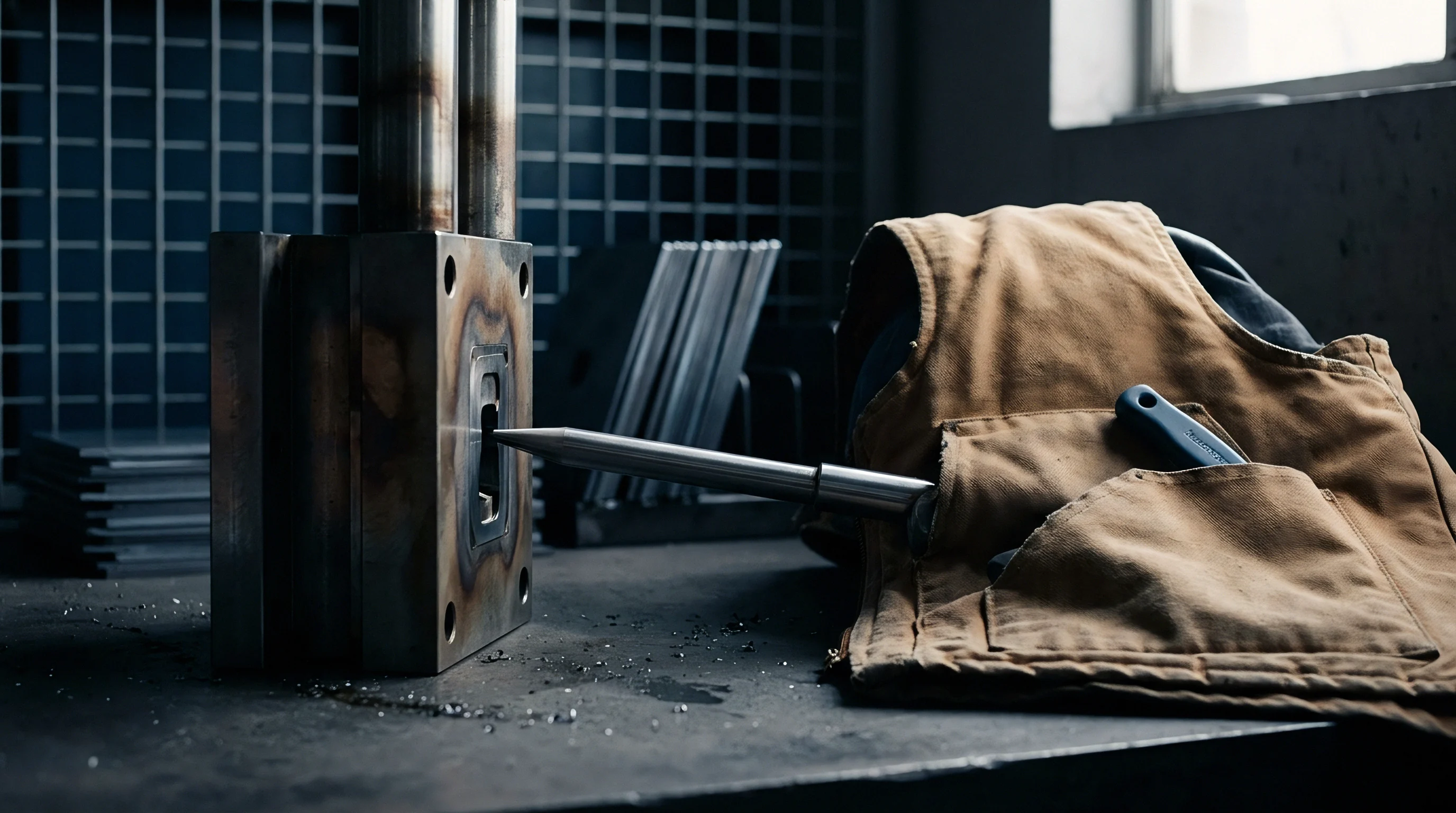
Clear physical identification is the first line of defense in any ownership dispute. Suppliers defending a retention claim routinely argue that contested tooling belongs to their internal inventory or forms part of their proprietary master setups. High-grade alloys like S136, H13, NAK80, and P20 look no different from ordinary mild steel once mounted, and without deep, unambiguous serial markings machined into the plates, court enforcement officers cannot confirm who owns what on the shop floor.
Engravings must be deep enough to resist tampering. Surface paint, riveted plates, and light chemical etching will not survive a production environment; suppliers can scrape off adhesive tags or mill away shallow etchings during routine toolroom maintenance. Ownership details should be CNC-milled directly into the main mold base, ejector housing, and core block faces to a minimum depth of one millimeter.
The engraved text must match the corporate name listed on the Chinese tax invoice and the tooling agreement letter for letter. Engraving a Western brand or an offshore subsidiary’s trading name creates evidentiary problems in local court, where judges look for an exact match between the physical steel and the entity named on the Chinese business license. Markings should include the full registered Chinese name of the buyer alongside the asset serial number.
Serialization needs to cover internal tooling as well as the outer base. When faced with an asset retrieval order, some molders swap out hardened multi-cavity inserts for cheaper aluminum or unhardened P20 test blocks before turning over the outer frame. Marking matching serial numbers across core plates, cavity inserts, slides, and hot runner manifolds makes it possible to confirm during an inventory audit that the complete assembly is intact.
A technical dossier serves as the engineering benchmark during repossession. This file should contain 3D CAD models, 2D assembly drawings, electrode layouts, hot runner schematics, and mill test certificates verifying steel heat treatment. If an incumbent supplier damages core inserts during a standoff, having the full dossier allows a replacement shop to machine new components without starting from scratch.
The financial stakes are clear in high-precision automotive applications. A 16-cavity hot-runner mold in S136 can cost 85,000 USD to build and take fourteen weeks to replace. If a factory freezes that tool during a price dispute, downtime losses on downstream assembly lines can run 12,000 USD a day.
With clear markings on the steel, a court preservation order can impound the mold within ten business days; without them, technical audits can stall recovery for over six months, pushing losses past two million dollars.
RFID tags and tamper-evident hardware add another layer of tracking. Sealing high-temperature passive RFID transponders inside the mold base lets auditors scan and log serial numbers without pulling the tool from the press. If a supplier tries to hide customer steel at a subcontractor’s workshop, handheld scanners allow quick verification during court-authorized site inspections.
Asset tags must resist physical removal and thermal breakdown. Molds operate under elevated temperature profiles and endure intense chemical exposure during molding cycles and solvent cleaning operations.
Suppliers also attempt to block extraction by claiming the tool incorporates factory-owned master frames or proprietary manifold components. They will concede customer ownership of the core inserts while arguing that the base plates, guide pillars, locator rings, and heating elements belong to the shop. This forces court officers to determine what can legally be disassembled and removed, slowing enforcement to a crawl.

Title
Under Chinese law, title to an injection mould does not transfer through simple contract declarations or proof of payment alone. The Civil Code requires a clean documentary trail showing precisely when and how ownership moved from the builder to the customer. A contract clause stating that the buyer owns the tooling from day one will not hold up if the underlying invoices, tax filings, and acceptance records do not align under Chinese evidentiary rules.
The official VAT invoice, or Fapiao, is the central piece of evidence for proving asset title in court. Issued through the State Taxation Administration, the Fapiao records tax liabilities, legal entity names, item descriptions, and settled values. Under Article 224 of the PRC Civil Code, judges treat this document as primary proof of property transfer.
A foreign buyer paying from an offshore account without obtaining a dedicated, itemized Fapiao in its registered name holds a weak legal position if ownership is challenged.
The line items on the Fapiao must identify the specific tooling. Broad descriptions like “engineering services,” “plastic prototypes,” or “machinery parts” fail to link the invoice to a particular mould. Buyers must require the vendor to list exact serial numbers, mould dimensions, and corresponding part numbers on the invoice itself, and cross-reference that Fapiao number inside the overarching tooling agreement.
Milestone payment schedules help pace title acquisition and limit exposure to retention claims. Standard agreements split payments across set stages: upfront deposit, T1 sample sign-off, dimensional verification, and final production acceptance. The contract should stipulate that title transfers incrementally with each milestone, or vests in full upon T1 approval, regardless of where the physical asset is stored.
| Documentary Evidence Type | Issuing Authority or Entity | Evidentiary Weight in PRC Courts | Common Evidentiary Defects |
|---|---|---|---|
| PRC Special Value-Added Tax Fapiao | State Taxation Administration | Primary legal proof of title transfer and paid consideration | Generic item description missing mold serial numbers |
| Bank Wire Transfer Receipts | Commercial Banking Institutions | Secondary proof of monetary consideration payment | Payment remitted by third-party affiliate entity without agency contract |
| Bilingual Tooling Ownership Contract | Contracting Enterprise Entities | Primary proof of legal intent and contractual title terms | Contract governed by foreign law without PRC court jurisdiction |
| Signed Physical Acceptance Certificates | Buyer Technical Inspection Team | Proof of milestone completion and asset delivery | Signature by unauthorized factory engineer without official company chop |
| Engraved Steel Photo Verification Logs | Third-Party Quality Inspection Firm | Physical identification proof linking asset to documentation | Photos lack timestamp or show un-engraved temporary paper tags |
The entities on the contract, bank transfers, and tax records must match exactly. If a parent company signs the agreement but an offshore trading affiliate wires the funds, Chinese courts may view the payment as unverified or executed by an unrelated party. Suppliers exploit these gaps by arguing they never received valid consideration from the named buyer.
Contracting parties, payment remitters, and invoice recipients need to be identical.
Keeping contracts separate is the simplest way to protect tooling title from manufacturing disputes. Combining tooling purchases and piece-part supply in a single document gives suppliers room to claim cross-defaults over scrap rates, quality issues, or volume shortfalls. A standalone Tooling Ownership and Bailment Agreement, isolated from the master supply contract, deprives the molder of grounds to hold tooling over part-pricing arguments.
Contractual title reservation clauses under Article 641 of the PRC Civil Code remain ineffective against third-party possessors unless official tax invoices and physical serial markers directly corroborate ownership claims.
Formal acceptance protocols close out the title transfer process. Once T1 samples meet specification, both parties should execute a Certificate of Tooling Ownership and Acceptance stamped with their registered corporate seals, or Chops. Under Chinese law, an official company chop on an acceptance certificate binds the enterprise, making it difficult for factory management to later claim title to the steel.
Securing clean legal title requires following a strict procedural sequence across the procurement cycle:
- Execute a standalone bilingual Tooling Ownership Agreement specifying PRC governing law and local court jurisdiction prior to issuing any financial deposits.
- Remit all milestone payments directly from the bank account of the legal entity named as the buyer in the primary tooling agreement.
- Inspect the physical mold steel at the molder’s facility to verify deep mechanical engraving of the buyer legal name and asset serial number prior to issuing the T1 milestone payment.
- Obtain an itemized PRC Special VAT Fapiao from the molder carrying the exact mold serial numbers and buyer corporate name matching the contract details.
- Secure a fully executed Certificate of Tooling Ownership and Acceptance stamped with the molder’s official company chop upon final sample approval.
Gaps in the chain of title undermine subsequent enforcement efforts. When a foreign company tries to secure a repossession order without matching Fapiao records and stamped acceptance documents, local courts will often dismiss the petition. Judges will not order the seizure of assets from a local factory if the paperwork carries conflicting corporate names or vague item descriptions.
To stand up in Chinese courts, the ownership clause must explicitly define the property boundaries: “All right, title, and interest in and to the custom injection moulds, including mold bases, core inserts, cavities, slides, hot runner systems, and technical drawings specified in Schedule A, shall vest exclusively in Buyer upon payment of the T1 milestone fee, independent of physical possession or ongoing component purchase disputes.”

Bailment
Bailment governs the legal custody of tooling while it remains on the supplier’s factory floor. Under Chapter 22 of the PRC Civil Code, a custody contract sets out specific duties for the bailee regarding care, permitted use, and return conditions. The molder acts strictly as a temporary custodian of customer property, with no legal right to alter, run, or hold the moulds outside the terms of the bailment agreement.
The agreement must explicitly restrict how the molder uses the asset. It should bar third-party production, unauthorized subcontracting, and the creation of duplicate tooling without prior written consent. Running unapproved production degrades cavity life through untracked cycles and creates intellectual property risks.
Moving tooling off-site without authorization should be defined as unlawful conversion under Chinese property rules.
Regular access for audit and maintenance ensures the buyer retains visibility over the asset. The bailment agreement should guarantee inspection rights for the buyer and its designated third parties, requiring the supplier to grant floor access within twenty-four hours of written notice. This prevents the factory from concealing wear, unapproved alterations, or unauthorized off-site moves.
Shot counters and maintenance logs provide an objective record of tool usage. Every moulding press records stroke cycles, and the supplier must maintain certified logs of total shots, cavity polishing, pin replacements, and general servicing. These records protect the buyer if a molder claims an asset is worn out or damaged when an extraction request is made.
Bailment agreements should require quarterly reconciliation reports signed by the molder’s toolroom manager. These audits need to include dated, high-resolution photographs showing the engraved serial numbers, cavity condition, and current machine setup. A steady paper trail prevents the molder from claiming during a standoff that the tool was lost, scrapped, or modified beyond identification.
Bailed injection moulds remaining on molder premises without active production orders or signed maintenance logs face elevated risk of unauthorized conversion or legal retention claims during commercial slowdowns.
Termination of custody must remain fully independent of part supply disputes. The contract should give the buyer an unqualified right to end bailment and demand physical return upon written notice. The terms must include an explicit waiver of any right of retention or set-off under Article 447, requiring the molder to surrender the tooling to designated freight carriers within forty-eight hours of notice.
- Unilateral Removal Authority empowers the buyer to enter molder premises and extract bailed tooling using independent logistics providers upon contract termination notice.
- Explicit Retention Waivers eliminate molder rights to assert statutory liens under PRC Civil Code Article 447 over customer-owned steel.
- Geographic Location Restrictions lock the physical placement of the tooling to a specific workshop address, prohibiting unauthorized off-site transfers.
- Mandatory Access Guarantees require molder security personnel to grant immediate entry to buyer inspection teams without advance approval gates.
- Daily Liquidated Damages penalize the molder at fixed daily monetary amounts for every twenty-four-hour period that tooling surrender is delayed past extraction notices.
Leaving idle moulds in a supplier’s facility after a production run ends is a frequent operational mistake. Without active purchase orders, stored tooling is vulnerable to opportunistic storage claims or disputed maintenance charges. Prompt extraction once production winds down is the only reliable way to safeguard customer-owned assets.
As an operational baseline, customer tooling should not remain in a supplier’s custody for more than thirty calendar days past the end of an active production run.


Dispute

Can Foreign Buyers Secure Immediate Tooling Repossession in PRC Courts?
When a supplier refuses to release tooling, relying on standard breach-of-contract litigation is rarely practical. Lawsuits for damages take time, while a shut-down assembly line creates immediate financial fallout. Buyers need to use provisional and pre-suit preservation remedies under the PRC Civil Procedure Law to secure physical control of the steel before it is moved or altered.
Property preservation under Article 103 of the Civil Procedure Law allows a claimant to ask the court to freeze, seal, or impound assets before or during a lawsuit. In an unlawful retention dispute, the buyer files an emergency preservation application with the basic-level People’s Court where the factory is located. If granted, court bailiffs visit the premises, affix official seals, or transfer the tooling to court-designated storage.
Courts require applicants to post a counter-guarantee bond to cover potential losses to the factory if the preservation order is later found improper. Judges accept cash deposits, local corporate guarantees, or preservation insurance bonds from approved Chinese commercial insurers. The bond value generally sits between fifty and one hundred percent of the declared asset value.
| Enforcement Route | Primary Forum or Authority | Average Execution Timeline | Relative Cost and Financial Exposure | Primary Operational Risk |
|---|---|---|---|---|
| Pre-Suit Property Preservation Order | Basic-Level PRC People’s Court | 5 to 12 business days | Moderate; requires 100% counter-guarantee insurance bond | Factory conceals tooling prior to bailiff arrival on site |
| Administrative MSA Mediation | Local Market Supervision Administration | 3 to 7 business days | Low; direct administrative negotiation without court fees | MSA lacks authority to physically seize assets without court order |
| Civil Lawsuit with Trial Execution | PRC Court or Arbitral Tribunal | 8 to 18 months | High; extensive legal fees, court costs, and long downtime losses | Tooling suffers physical degradation or unauthorized modification during litigation |
| Public Security Criminal Complaint | Local Public Security Bureau (PSB) | 2 to 5 business days | Low; criminal investigation initiation | PSB rejects dispute as purely commercial enterprise conflict |
Offshore arbitration clauses can complicate emergency recovery. Western contracts often stipulate arbitration in Hong Kong, Singapore, or London, but foreign tribunals cannot send bailiffs into a Chinese workshop to seize physical assets. Tooling contracts should include clear provisions granting local Chinese courts jurisdiction over interim property preservation, asset searches, and physical recovery within the PRC.
Administrative routes through the local Market Supervision Administration or Public Security Bureau can sometimes support court proceedings. If a factory holds tooling without any underlying contract or proof of debt, a buyer can file a complaint for unlawful conversion. While police generally avoid commercial contract disagreements, clear proof of title combined with bad-faith extortion can prompt local authorities to inspect the premises and pressure the factory to return the goods.
Preservation filings require a complete evidentiary package proving ownership and precise location:
- Original Stamped Fapiao receipts matching exact tool serial numbers and buyer corporate registration names.
- Bilingual Tooling Bailment Contract showing explicit PRC court jurisdiction and clear waivers of molder retention rights.
- High-Resolution Photographs showing deep mechanical engraving of asset serial numbers on the physical mold base inside the molder’s plant.
- Official Financial Proof showing wire transfer receipts remitted directly from the buyer enterprise bank account to the molder.
- Commercial Written Notices showing formal rejection of disputed storage fees or engineering charges submitted prior to litigation initiation.
A major risk during a dispute is deliberate tool sabotage. If a supplier anticipates an enforcement order, it may strip hot runner wiring, remove guide pins, or grind down precision core surfaces to make the tool unusable for a competitor. Applying for ex-parte preservation without advance notice to the factory is often the only way to protect the steel before bailiffs arrive.
This dynamic leaves open an unresolved question: how far can foreign buyers rely on local judicial enforcement when the molder operates as the dominant employer within a lower-tier administrative region?

Extraction
Physical extraction is the final, practical phase of recovering tooling. Once legal rights are settled or a preservation order is issued, retrieving heavy steel requires careful logistical handling. Injection moulds weighing multiple tons require overhead cranes, heavy forklifts, air-ride transport, and experienced riggers.
Coordinating access to the factory loading bay demands active oversight of gate passes, security teams, and local transport schedules.
Enforcement through court bailiffs provides necessary legal authority on site. When executing a preservation order, bailiffs enter the facility alongside local police if pushback is expected. The buyer’s operations team provides the rigging crew and air-ride trucks.
Court officers match serial numbers against legal filings, supervise rigging, complete the official seizure record, and sign transfer paperwork at the factory gate.
Once recovered, tooling requires immediate technical inspection before restarting production. Moulds retrieved from a disputed site frequently turn up with missing hot runner controllers, damaged cooling lines, oxidized core faces, or misaligned slides. The receiving toolroom must perform a full teardown, CMM dimensional verification, and dry-cycle testing before mounting the mould into a press.
Re-qualifying the mould at a new vendor means matching press tonnage, tie-bar clearance, ejector patterns, and shrinkage parameters. Tools built for specific machine models may need adapter plates or replumbed hydraulics to run elsewhere. Keeping complete electrode schematics and CAD files on hand allows the new shop to machine replacement inserts quickly if post-extraction inspection reveals damage.
Escrow payment terms give buyers necessary leverage during physical handover. Contracts should route final milestones through escrow or hold back ten percent of the contract value until the tooling is delivered to the new plant, mounted, and qualified via sample inspection. Tying final release of funds to successful handover removes any financial incentive for the old supplier to delay extraction or hold onto ancillary hardware.
Physical extraction operations executed without real-time judicial supervision or explicit molder gate clearance face severe legal liability risks under local Chinese trespass and administrative security regulations.
The cost of a contested retrieval highlights why preventative contracts are essential. Between legal filings, preservation insurance premiums, rigging teams, emergency transport, adapter tooling, and lost production, total recovery costs routinely run three to five times the original price of the mould. Securing clean title, obtaining matching tax invoices, engraving serial numbers, and isolating bailment terms in the initial contract remains the only cost-effective way to avoid retention disputes.
Logistics teams must make sure all dedicated auxiliary equipment is retrieved alongside the mould base. This includes hot runner controllers, hydraulic power units, robotic end-of-arm tooling, and custom water manifolds. Suppliers will sometimes release the main steel frame while retaining custom end-of-arm tooling or controllers, stalling production at the new plant.
Auditing the full bill of materials before loading ensures that all essential components make it past the gate.
Recovery is complete only when the replacement vendor confirms full mechanical function, verifies part dimensions on CMM, and begins production runs under a secure, isolated bailment structure.