Establishing Physical Tooling Ownership in Chinese Manufacturing Supply Contracts
Physical tooling ownership in China requires separate bilingual agreements, itemized VAT fapiao, permanent stamped asset plates, and verified shop-floor custody.


Title
A crated injection mold sits on a pallet in Ningbo while two offshore bank transfers clear. The purchase order describes finished plastic housings, yet the steel tooling inside the molding bay represents forty thousand dollars of unsegregated capital. International buyers routinely discover that paying a tooling invoice guarantees neither physical access nor registered ownership under Chinese jurisdiction.
Article 224 and Article 311 of the PRC Civil Code establish that possession of movable property creates a legal presumption of ownership in favor of the party holding the asset. When a local supplier holds the mold in its workshop, third parties, including sub-tier contractors and judicial creditors, legally presume the supplier owns that tooling unless contrary public notice or definitive title documentation exists.
Western supply agreements frequently rely on blanket ownership clauses stating that all molds, dies, and fixtures remain the exclusive property of the buyer. In a Chinese court or before an arbitration tribunal seated in Shanghai or Shenzhen, those overseas contractual recitals collapse when confronted with conflicting operational documents. Chinese commercial law treats tooling ownership as a property right governed by Book II of the PRC Civil Code rather than a purely contractual promise governed solely by Book III.
The manufacturer retains statutory lien rights under Article 447 of the PRC Civil Code, which permits a possessor to detain personal property when an outstanding debt arises from the underlying processing contract. An unpaid batch of finished parts, an unresolved engineering change fee, or a disputed storage charge gives the factory legal authorization to padlock the tool inside the press room.
Under Article 447 of the PRC Civil Code, an unsettled invoice for piece-part production creates an enforceable possessory lien over overseas-funded tooling held on the shop floor.
Contractual clarity demands an independent tooling fabrication and bailment agreement written directly in Chinese, executed under Chinese governing law, and separated entirely from purchase orders for finished piece parts. Conflating mold fabrication costs with unit piece prices obscures the transaction. When an overseas enterprise amortizes tooling expenses across the first one hundred thousand units produced, the factory registers the tooling steel as internal corporate inventory.
Chinese tax and accounting rules treat production machinery purchased by the supplier as supplier assets, depreciated over three to five years under standard corporate enterprise income tax schedules. Reclaiming that tooling requires proving that the buyer bought a distinct capital asset rather than simply agreeing to an inflated piece-part tariff during early production runs.
Legal counsel in cross-border manufacturing disputes repeatedly encounter supply arrangements where tooling payments flowed through Hong Kong intermediaries or offshore trading entities without matching customs declarations or local tax receipts. The foreign entity believes it purchased a production tool. The domestic Chinese factory records the incoming wire as an advance operating deposit or unallocated production subsidy.
If the relationship fractures over quality drift or unannounced cycle-time extensions, the foreign brand faces an entrenched counterparty possessing physical custody, valid corporate utility accounts, and local tax records indicating asset stewardship. The buyer holds an English-language document signed by a sales representative who lacked statutory authority under the factory’s registered corporate articles.
Defaulting on the separation of component pricing from asset acquisition yields protracted administrative impasses, complete mold redesign expenses, and months of lost market shipments while new production lines undergo tooling fabrication from scratch.

Invoice
Tax documentation determines legal asset recognition within the Chinese domestic legal system. The specific tax instrument that establishes property acquisition is the official value-added tax invoice, known as the fapiao, issued through the national Golden Tax System. A pro forma commercial invoice issued in US dollars by an export agent does not establish legal ownership of equipment located on the mainland.
The Chinese Civil Code and domestic administrative courts evaluate whether the buyer holds a dedicated special VAT invoice describing the tooling asset by its specific technical specifications, cavity count, mold base metallurgy, and individual serial identifier.
Foreign buyers operating without a local wholly foreign-owned enterprise or domestic subsidiary face a structural obstacle: an overseas company cannot directly receive a domestic Chinese VAT fapiao. The transaction requires a structured tri-party framework or a recognized non-resident capital equipment acquisition structure. In this framework, the local tooling fabricator issues the VAT invoice to a bonded entity, a domestic procurement partner, or directly records the foreign principal on the export customs manifest when the mold clears mainland borders.
If the mold remains inside China for long-term component production, the supply contract must bind the factory to issue a formal receipt recognizing that payments received from abroad directly extinguish the purchase price of the specified machinery.
The table below outlines the structural mechanisms through which overseas brands finance tooling, the corresponding tax instruments, and the resulting legal risks under Chinese jurisdiction.
| Payment Structure | Documentation Instrument | Tax Reconciliation | Enforceability in PRC Courts |
|---|---|---|---|
| Direct Foreign Wire for Tooling Milestone | Commercial Invoice and Bank Remittance Slip | Non-taxable offshore receipt or export service filing | Moderate, dependent on explicit bilateral agreement |
| Unit Price Amortization across Parts | Standard Component Fapiao (General Merchandise) | Factory claims tooling steel as internal manufacturing asset | Negligible, factory maintains legal presumption of ownership |
| Dedicated Tooling Agreement via Domestic WFOE | Special VAT Fapiao with Itemized Asset Nomenclature | Direct asset capitalization on domestic balance sheet | Absolute, establishes undeniable statutory property title |
| Escrow Disbursement via Third-Party Agent | Tri-party Entrustment Agreement and Escrow Receipt | Withholding tax clearance and service reconciliation | High, provided asset serials match escrow release terms |
Milestone schedules define how control shifts during fabrication. Tooling agreements must tie cash disbursements to tangible engineering checkpoints rather than arbitrary calendar intervals. A disciplined contract divides payments into four distinct gates: initial steel cutting, first trial shots (T1), final engineering sign-off with golden sample dimensioning, and production-line verification under operating cycle speeds.
The supplier signs a specific bilingual title transfer certificate at the T1 stage, stating that equitable title vests progressively in the foreign buyer as funds clear, culminating in absolute legal title upon final sample sign-off.
Cross-border dispute records show that factories facing contract termination assert fictitious labor and modification expenses. They issue supplemental debit notes for tool optimization, runner re-engineering, or electrical discharge machining (EDM) operations. To counter these claims, the core agreement specifies that the fixed tooling contract price includes all adjustments, sample trials, surface texturing, and initial spare components.
Any change to the tooling architecture requires a countersigned engineering change order with an agreed price adjustment; otherwise, the baseline contract extinguishes all statutory claims for unapproved work.
Enforcing title retention requires specific documentary exhibits integrated directly into the transaction file:
- Individualized asset schedules identifying the mold by unique internal serial numbers, steel heat-treatment lot records, shot capacity ratings, and physical dimensions.
- Bilingual title certificates executed concurrently with the final disbursement, signed by the legal representative of the factory and bearing the official corporate red seal.
- Official VAT fapiao copies referencing the explicit equipment serial numbers on the invoice description line rather than generic machining labor entries.
- Bank payment vouchers demonstrating direct payment correlation between the buyer bank account and the corporate bank account registered on the supplier business license.
The contract stipulates that failure to provide the itemized asset certificate within ten business days of final payment constitutes a material breach triggering an immediate contractual penalty and forfeiture of any remaining maintenance deposits.

Plate
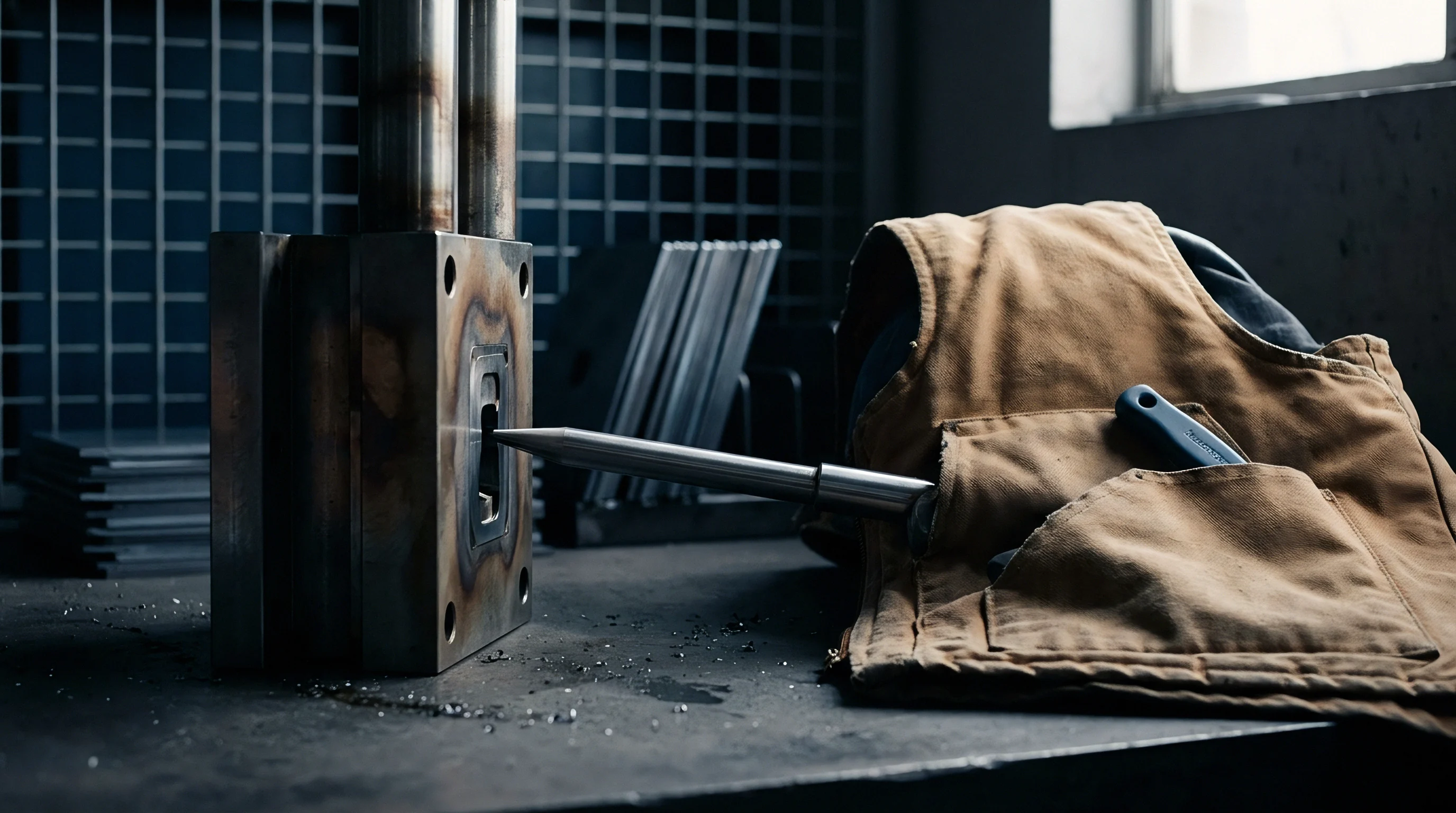
Legal title remains theoretical until physical steel reflects contractual language. An unmarked mold resting among hundreds of identical P20 or 718 steel blocks inside a tier-two injection molding workshop in Dongguan is indistinguishable from factory inventory. During sudden factory audits, dispute walkouts, or judicial seizures, bailiffs and local administrative officials inspect the physical mold base for visible, immutable proof of ownership.
If the tool displays only the supplier internal shop-floor chalk markings, the asset remains vulnerable to third-party claims and supplier liens.

Where Does Physical Possession Sever Legal Title?
Separation occurs when permanent, physical markers overcome the statutory presumption of custody. PRC judges and enforcement officers require indisputable evidence before authorizing the extraction of machinery from an operating industrial premise. The contract must stipulate that the mold maker mounts a permanently riveted or deeply engraved bilingual stainless-steel asset tag directly onto the non-operating face of the mold base.
This plate must be installed before the mold runs its first trial shot. Screws and adhesive labels fail this requirement; local factory technicians remove adhesive labels with solvent within minutes during commercial confrontations.
A stainless-steel asset plate riveted to the mold base with bilingual ownership notices prevents good-faith acquisition defenses under Article 311 of the PRC Civil Code.
The physical plaque contains specific statutory notices. It identifies the foreign enterprise as the sole proprietary owner, details the corporate registration number, provides the unique global asset code, and states in simplified Chinese that unauthorized relocation, modification, pledging, or operational cycling of the tooling constitutes an intentional tort under Chinese law. This explicit marking eliminates the legal defense of bona fide acquisition by third parties under Article 311 of the PRC Civil Code.
If an insolvent supplier attempts to sell, pledge, or lease the mold to an unsuspecting sub-contractor, the physical plate destroys the buyer good-faith defense, ensuring the real owner retains immediate replevin rights.
Physical inspection audits verify asset tagging through rigorous physical shop-floor protocols:
- Plaque attachment integrity confirmed by checking cold-rolled steel rivets or deep mechanical stamping directly into the mold base cavity plate.
- Bilingual text legibility verified under standard shop-floor illumination, ensuring Chinese characters for asset ownership remain sharp and unambiguous.
- Dimensional coordinate indexing cross-referenced against computerized numerical control (CNC) machining files to ensure the tag location does not interfere with clamping fixtures.
- Serial number synchronization checked against the core, cavity blocks, slide mechanisms, and ejector plates to prevent component swapping.
Tooling validation requires direct visual confirmation on the production floor. Verification across eight time zones fails when relying on staged photographs supplied via messaging applications. Factory personnel frequently swap asset plaques between functional and defective mold bases to pass desktop audits.
A qualified engineering auditor must touch the cold steel, inspect the rivet heads, check for tampering around the engraving, and log the physical presence of the tool inside the specified facility coordinates.
The supplier routinely claims that engraving the mold base weakens structural integrity or that the mold arrived from the CNC workshop too late to attach the plate before scheduled trial runs.

Custody
Transferring an accepted mold into active production begins the bailment relationship. Under Chinese civil law, bailment, classified as a custody contract under Chapter XXI of Book III of the PRC Civil Code, imposes strict fiduciary obligations upon the bailee. The manufacturer holds the asset exclusively for fabricating component parts on behalf of the tool owner.
In standard operations, factories view tooling custody as leverage. They run unauthorized third-party shifts at night, sell overrun stock into domestic e-commerce channels, or run unapproved engineering trials that accelerate mold fatigue and steel deformation.
Preserving the asset demands a standalone Tooling Custody and Bailment Agreement executed simultaneously with the master manufacturing agreement. This document defines the operational boundaries of the bailment. It states explicitly that the factory serves as an uncompensated or compensated custodian with no proprietary interest in the asset.
The contract mandates that the tool remain permanently at the specific registered factory facility identified by its physical street address and municipal building number. Subcontracting production to another workshop or moving the mold to an affiliate plant without prior written consent constitutes an immediate contractual breach justifying unilateral contract termination, immediate repossession, and predetermined liquidated damages.
Cycle telemetry provides objective tracking that protects asset life. Every injection mold or progressive stamping die possesses a finite lifespan dictated by its core and cavity metallurgy. An unhardened aluminum prototype tool degrades after ten thousand cycles.
Premium Nak80 steel withstands three hundred thousand shots, while hardened H13 or S7 tool steel operating with proper cooling and lubrication reaches one million cycles. Without mechanical or electronic cycle counters, an overseas brand cannot detect unapproved production volumes.
The table below summarizes tooling steel classifications, standard operational life expectancies, and mandatory preventive maintenance cadences that must be governed by the custody agreement.
| Steel Grade | Rockwell Hardness (HRC) | Expected Lifespan (Shots) | Mandatory Maintenance Cadence |
|---|---|---|---|
| P20 (Modified) | 28 – 32 | 150,000 – 300,000 | Clean and lubricate slides every 25,000 cycles |
| 718H (Pre-hardened) | 33 – 38 | 300,000 – 500,000 | Inspect parting lines and ejector pins every 50,000 cycles |
| NAK80 (Mirror Surface) | 37 – 43 | 400,000 – 600,000 | Ultrasonic wash and polish re-conditioning every 40,000 cycles |
| H13 (Core/Cavity Through-hardened) | 48 – 52 | 800,000 – 1,000,000 | Complete teardown, stress relief, and seal replacement at 100,000 cycles |
Maintaining tooling accuracy requires regular physical intervention. Injection molds undergo intense thermal cycling, with internal temperatures alternating between chilled coolant flows at twelve degrees Celsius and molten polymer injection exceeding two hundred and forty degrees. This operational environment degrades O-rings, clogs conformal cooling channels with mineral scale, and erodes sharp shut-off edges.
In the wider commercial world, high-pressure hydraulic systems depend on strict preventive maintenance schedules to prevent catastrophic seal failure, and precision injection molds operate under identical thermodynamic realities. The custody contract must assign all preventive maintenance costs to the factory as part of standard piece-part conversion margins, while specifying that major tool overhauls resulting from normal operational wear remain subject to joint engineering reviews.
A tooling custodian who fails to log preventive maintenance cycles forfeits the right to assert mold degradation as an excuse for component dimensional failure.
Cycle counts dictate replacement and repair responsibilities. The custody contract requires the installation of non-resettable, tamper-evident digital stroke counters embedded inside the mold base housing. During weekly operational reporting reviews, the factory submits high-resolution photographs of the counter along with production yields.
Discrepancies between shipped component quantities and counter increments reveal defective yield rates, unrecorded scrap, or covert third-party manufacturing runs. Modern procurement teams deploy cellular or low-power wide-area network telemetry units integrated into the mold base to monitor geographic movement, internal clamping shocks, and operating hours across multiple production shifts.
When monitoring cycle count anomalies, the buyer executes an escalating operational procedure:
- Audit the digital stroke counter against the total finished goods packing slips and scrap records within twenty-four hours of receiving the weekly report.
- Issue a formal operational notice requiring the factory general manager to reconcile unexplained cycle differentials exceeding five percent within two business days.
- Dispatch an unannounced local site inspector to conduct an on-machine inspection of the mold parting line, slide wear plates, and internal shot counters.
- Withhold upcoming purchase order deposits if the factory management refuses physical floor access or fails to substantiate cycle discrepancies.
An asset unprotected by clear maintenance protocols degrades into useless scrap steel long before legal title ever comes into dispute.

Recovery
Extracting tooling from a hostile manufacturing facility tests the operational depth of the contract. When commercial relationships collapse, Chinese factory gates close. Security guards turn away foreign representatives, logistics providers refuse to cross factory thresholds without written dispatch notes signed by the domestic plant manager, and the local police department classifies the confrontation as a civil commercial dispute outside their jurisdiction.
Unilateral physical attempts to load tooling onto flatbed transport trucks without proper legal preparation lead to police intervention, administrative detention of personnel, and immediate counter-claims for criminal trespass or property damage.

Whose Claim Prevails during Factory Insolvency?
Priorities shift fundamentally when a Chinese factory enters bankruptcy or faces asset freezing by local creditors. Under the PRC Enterprise Bankruptcy Law, all unsegregated assets found on the corporate premises are presumed to belong to the bankrupt estate. A foreign buyer lacking registered property title, matching VAT invoices, and clear asset plates must file an exclusion claim (异议申请) before the court-appointed bankruptcy administrator.
If the administrator rejects the claim, the foreign company becomes an unsecured general creditor, watching its custom production molds auctioned off to satisfy local worker wage arrears, unpaid social insurance obligations, and domestic tax liens. Registered bailment documentation with photographic asset tag verification provides the only mechanism to exclude the tooling from the liquidation pool.
Judicial preservation orders provide the formal legal avenue for asset recovery. Article 103 of the PRC Civil Procedure Law authorizes a party to apply for pre-litigation or litigation property preservation (诉前财产保全). The foreign enterprise petitions a basic-level people’s court in the jurisdiction where the factory operates, seeking an urgent ruling to seal and freeze the tooling.
To obtain this relief, the applicant must provide financial counter-security, typically through a litigation guarantee insurance policy issued by a domestic Chinese insurance company for an annual premium ranging between 0.1 percent and 0.5 percent of the declared asset value.
Enforcement procedures follow strict court protocols once the judge signs the preservation ruling. A court bailiff, accompanied by the applicant authorized Chinese legal counsel, enters the workshop with the official enforcement decree. The bailiff places physical court seals across the mold parting line or orders the immediate removal of the tool to a court-designated neutral bonded warehouse.
In practice, obtaining this judicial order requires five to fifteen working days under expedited conditions, resting on an evidentiary dossier that contains the Chinese-language tooling agreement, matching bank remittance records, the registered fapiao, and high-resolution photographs of the affixed asset plaque.
The financial calculations governing physical repossession require clear-headed evaluation. Recovering a tool through formal judicial channels involves measurable commercial outlays. Legal fees for an urgent recovery action in coastal manufacturing hubs range from eight thousand to twenty-five thousand US dollars.
Counter-security insurance costs several hundred dollars. Specialized heavy rigging, mobile crane rentals, bonded freight transport, and secure warehouse storage add another three thousand to eight thousand dollars depending on the mold physical tonnage. If the tooling steel has surpassed seventy percent of its operational fatigue life, fabricating a replacement mold with an alternative supplier often costs less than legal extraction.
Conversely, if the tooling produces proprietary, patent-protected components where mold theft threatens brand equity, recovery expenses become mandatory investments to protect intellectual property.
Evidentiary precision determines the outcome of any judicial extraction proceeding. In Chinese judicial practice, courts rely on the high-watermark evidentiary standard for commercial property claims. The foreign claimant presents a consistent documentation chain: the bilingual agreement containing an unambiguous dispute resolution clause pointing to a local Chinese court or domestic arbitration commission (such as CIETAC or SCIA), certified bank records proving full payment, engineering sign-off sheets, and dated inspection logs.
If any link in that documentary chain fails, the people’s court suspends enforcement, leaving the production tool padlocked inside the defendant factory while commercial seasons slip away.
The ultimate question confronting an overseas brand remains whether domestic legal mechanisms can execute asset recovery swiftly enough to prevent an uncooperative supplier from duplicating core cavity inserts before the court bailiff arrives at the factory gate.